Battery Audits, Data Centre Rules and Waroona: Sparky News
61% of audited batteries rated substandard, new data centre grid rules, NZ's large-load playbook and Waroona breaks ground. What it means for sparkies.
Some weeks the electrical news is all ribbon-cuttings and record megawatts. This one was different, and honestly, I think it was more useful. The headline theme of the past fortnight across Australia and New Zealand is quality and readiness: regulators publishing hard numbers on how well batteries are being installed, new grid rules telling data centres how they must behave, New Zealand writing a rulebook for big loads, and Queensland resetting the terms for major public projects.
None of that is a reason to worry. It's what a maturing industry looks like. And for sparkies who take pride in their work, it's genuinely good news, because when the bar rises, the people already clearing it get more valuable. Here's what happened and what I'd do about it.
The battery inspection numbers are in, and they're a wake-up call
On 16 November, pv magazine reported on the Clean Energy Regulator's annual inspection report for the 2025–26 financial year under the Small-scale Renewable Energy Scheme (SRES). The CER completed a record 6,554 inspections: 3,425 solar battery systems and 3,129 solar systems.
The headline figure is the one everyone's talking about: 61.19% of the batteries inspected were rated "substandard", meaning the installation had faults that need to be fixed. For solar, the figure was 23.11%. The good news sits right next to it: fewer than 1% of either were rated "unsafe" (0.95% for batteries and 0.93% for solar).
What jumps out at me is why systems failed. According to the report, the problems were almost entirely workmanship, not faulty products. For batteries, the most common issues were:
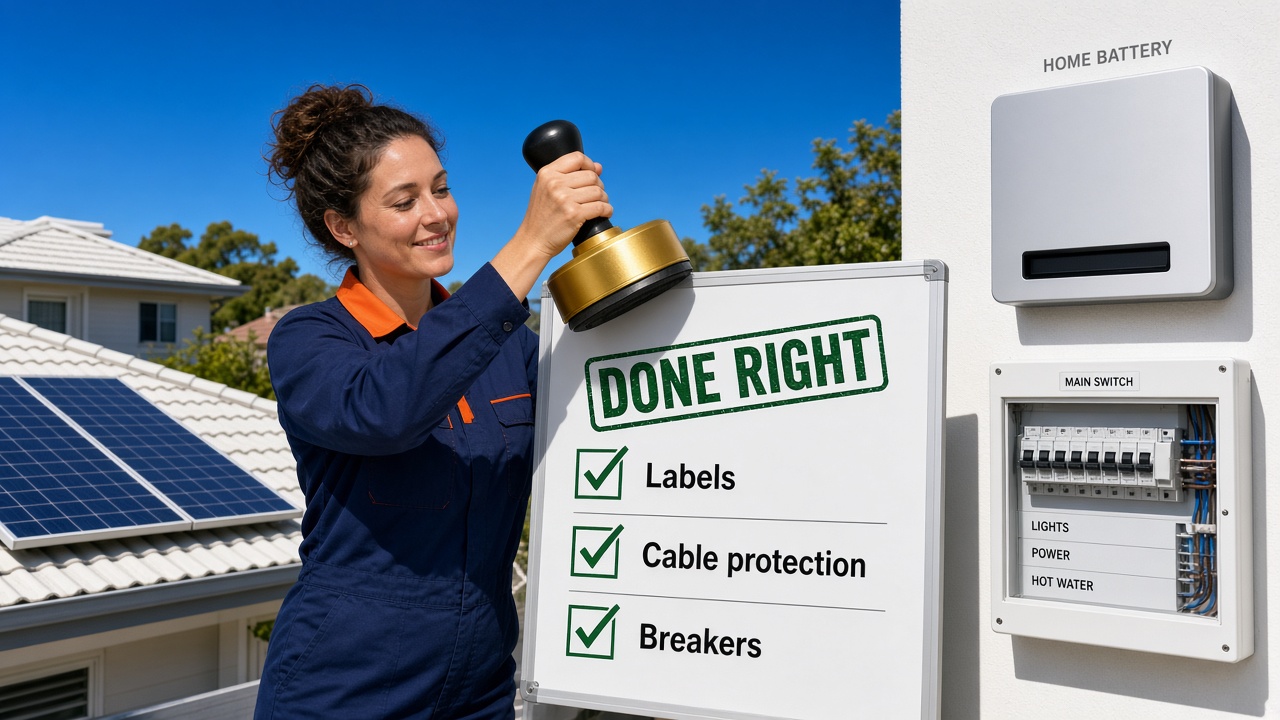
- missing or incorrect labelling
- incorrectly configured or missing wiring
- insufficiently rated circuit protection
- inadequate physical protection for cables and the battery itself.
For solar, it was incorrectly sized or fitted cabling and conduits, poor bonding or earthing of panel frames, incompatible or badly installed DC connectors, and dodgy mounting structures.
Here's my take. These are fixable problems. Labels, cable protection and correctly rated breakers are not rocket science, and they're exactly the kind of things that slip when crews are flat out. And we have been flat out: the Cheaper Home Batteries program has driven a boom that's put batteries in hundreds of thousands of homes. Speed has a cost, and this report is the bill.
The CER isn't being shy about the consequences either. Since 1 July 2025 it has contacted more than 830 installers about adverse inspection outcomes, including 716 advisory letters for first-time non-compliance and 121 warning letters for repeat offenders. It can suspend installers who rack up three or more adverse inspection reports, or three or more false or misleading written statements. Its message is blunt and, I reckon, spot on: "do it once and do it well."
A big retailer gets shown the door
The regulator also showed it's willing to act at the top end. On 11 November, pv magazine Australia reported that the CER had permanently suspended 1 Solar Australia Pty Ltd, trading as Solar Power Nation, as a registered person under the SRES. The CER said it was no longer satisfied the company met the "fit and proper" requirements, which means it can't create the STCs needed to access federal rebates.
According to the report, NSW's Building Commission had received more than 240 complaints about the company, and it had previously been expelled as an approved seller under the New Energy Tech Consumer Code. The company has 60 days to request a review. CER Chair Tony Chappel said the regulator has "a zero-tolerance approach for any poor business practice that can create an adverse outcome for the customer."
I'm not going to pile on a business. The bigger point for electricians is this: the rebate system is now actively policing quality, from individual installs to the biggest retailers. If you're a sparky subcontracting to a retailer, your name is on the paperwork. Choose who you work with carefully, and make sure their sales promises match what you can install properly.
What I'd actually do about it
If you install solar and batteries, here's my practical checklist for the next month:
- Audit your own last ten jobs. Pull the photos and check them against the common failure list above: labels, cable protection, breaker ratings, earthing, DC connectors. If you find something, go back and fix it before an inspector does.
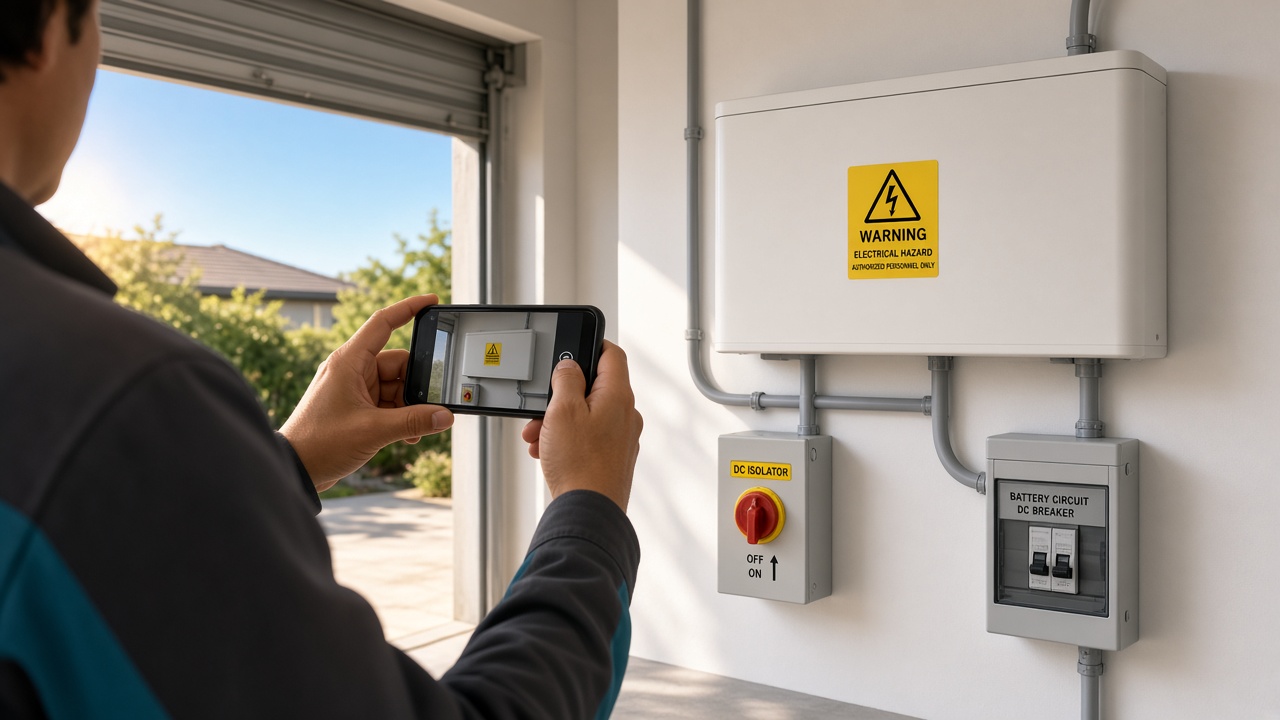
- Build a pre-handover photo routine. Make the same set of photos on every job non-negotiable. It protects you, and it trains your apprentices what "finished" looks like.
- Don't let the run-up to Christmas squeeze quality. It's the busiest time of year for installs. The temptation to cut a corner is highest exactly when the risk is highest.
- Treat quality as a selling point. Customers read these headlines too. A contractor who can say "we'd pass a CER inspection on every job" has a story worth telling.
Data centres must now ride through grid disturbances
Moving up a few voltage levels, the Australian Energy Market Commission published its final rule Improving the NEM Access Standards – Package 2 on 12 November, and it took effect immediately. The AEMC's announcement is squarely about the AI data centre wave.
The context is staggering. The AEMC notes data centre electricity demand is forecast to grow sevenfold, from 5 to 34 terawatt hours by 2035, lifting data centres' share of demand from about 3% to about 13%. The new rule:
- sets a clear 30 MW threshold for "large inverter-based loads", including big data centres
- requires those loads to ride through certain power system disturbances instead of disconnecting unnecessarily
- makes network businesses consider the combined impact of nearby large loads
- asks AEMO to develop modelling guidance for large loads.
As Clayton Utz explains, the Schedule 5.3 access standards now apply automatically to any inverter-based load of 30 MW or more, whether it connects to transmission or distribution, and the definition is technology-neutral, covering inverters, converters and rectifiers. Applicants well advanced in negotiations get a six-month grace period.
Why should an electrician care about a market rule? Because ride-through doesn't happen on paper. It happens in the UPS systems, the power electronics, the protection settings and the control schemes inside these campuses, and it all has to be proven during commissioning. Every data centre above 30 MW now has a tougher test to pass, and that means more work for commissioning electricians, protection technicians and test engineers who understand how power electronics behave under a fault. I love this, because it rewards deep technical skill rather than just volume.
New Zealand writes its own large-load playbook
Across the Tasman, Transpower is doing something very similar. Its System Operator has published an initial Technical Guideline for Commissioning Large Loads (GL-EA-1370) for loads of 10 MW or more. Transpower says data centres "pose unique stability challenges which necessitate specific modelling and power system study requirements", and asks large-load customers to submit an Asset Capability Statement. It expects aspects of the guideline to be written into the Electricity Industry Participation Code over time.
Alongside that, Transpower has released Connections Management Framework 4.0, which brings load connections into the framework with extra information requirements for large loads. It briefly paused new load applications on 17 November so applicants could get across the changes, and resumes accepting them on Monday 23 November under the new process. Generation and storage applications aren't affected beyond a new form.
My read: New Zealand is getting ready for data centres and electrification at scale, and it's doing it methodically. For Kiwi sparkies and power technicians, the commissioning and testing side of large-load connections is going to be a growing niche, and it's the sort of specialist skill that travels well across the ditch.
Queensland resets the rules on big public projects
On 17 November, NECA welcomed the Queensland Construction Productivity Code 2026. The Code applies to publicly funded construction contracts over $150 million, with a mechanism to apply it to smaller projects in some cases, and covers industrial relations, productivity, right of entry, freedom of association and contractor compliance.
What I like here is the small-business angle. NECA points out the Code recognises a contractor's position in the contracting chain and its practical capacity to influence conduct, with exemptions where strict application could stop small businesses winning government work. NECA Queensland Executive Director Patrick Murphy said "the Government has got the direction right, but implementation will be critical", and pointed to hospitals, transport, energy, communications and the "enormous pipeline leading into Brisbane 2032".
If you run a Queensland electrical business and you've been wondering whether to chase government-funded work, this is the moment to understand the Code and line up your compliance. The Olympic pipeline is a once-in-a-generation opportunity.
And one big build to finish on: Waroona breaks ground
To end on a high, Frontier Energy has broken ground on Stage One of its Waroona Renewable Energy Project, about 120 km south of Perth: a 132 MW solar farm paired with an 81.5 MW / 6.9-hour battery, connecting to WA's main grid via the 330 kV Landwehr Terminal. First generation is scheduled for 2028.
WA contractor Monford Group holds the fixed-price EPC contract, including construction and commissioning. Field piling for the trackers comes first, with module installation and balance of plant scheduled from early 2027. Frontier's longer-term ambition is around 1 GW of solar and 660 MW of storage by 2031, and Stage Two already has development approval.
For WA sparkies, especially around Collie, Mandurah and the South West, that's a multi-year runway of DC, battery, HV and commissioning work right on the doorstep.
The bottom line
Put these stories together and a clear picture emerges. Australia and New Zealand are building faster than ever, and the system is now insisting that it's built well: proper labels and cable protection on home batteries, data centres that stay on through a grid wobble, large loads proven before they connect, and big public projects run productively.
That's a future I'm excited about, because it pays a premium for skill. The electricians who test thoroughly, document properly and understand protection, commissioning and power electronics are going to be in more demand than ever. If that's you, or you'd like it to be, browse the latest electrical jobs across Australia and New Zealand.