
What Does an Electrical Apprentice Do? How to Become One in 2026
How to become an electrician through an apprenticeship in Australia or NZ: what apprentices do, 2026 award pay, incentives of up to $10,000 and who's hiring.
Emma Jepsen started her electrical apprenticeship on $13.50 an hour while finishing a commerce degree. Six years after qualifying, the 26-year-old Melbourne sparky earns $46 an hour, has bought and renovated her own apartment, and told Yahoo News Australia this week that switching to the trade was "by far the best decision I've made for myself in terms of career choices."
I love that story, because it nails the deal. An apprenticeship asks you to accept lower pay for a few years while you learn. In return you end up with a licence, a skill that's in demand pretty much everywhere, and no uni debt. For this instalment of our "what does a ___ do" series, I want to cover the role every electrician starts with: the electrical apprentice.
The quick answer
An electrical apprentice is a trainee electrician who works for an employer while studying for a trade qualification. In Australia, that's usually four years, ending in the UEE30820 Certificate III in Electrotechnology Electrician and then a licence from your state regulator. In New Zealand, it's an apprenticeship through a Board-recognised training organisation, ending in registration with the Electrical Workers Registration Board. You earn from day one, your pay rises every year, and in Australia eligible apprentices can get up to $10,000 in government incentive payments on top of their wages.
What an electrical apprentice actually does
The honest version: in your first year you'll carry a lot of conduit, pull a lot of cable and sweep a lot of floors. That's normal, and the good apprentices treat it as part of learning how a site works.
Very quickly, though, the work gets more interesting. Under supervision, apprentices:
- Run cables and install wiring in houses, apartments, shops, factories and commercial buildings.
- Fit off power points, lights, switches, smoke alarms and appliances.
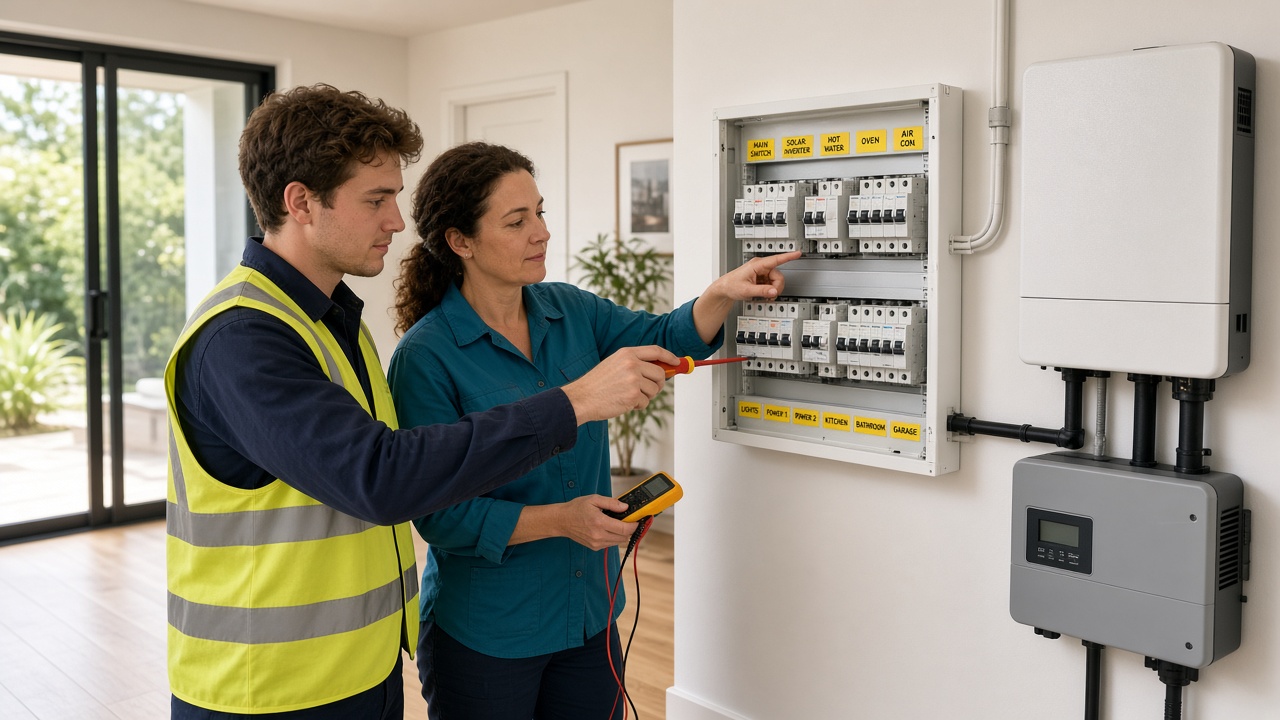
- Help build and connect switchboards, and learn how circuits are protected.
- Test and fault-find, using insulation testers and multimeters to check work is safe before it's switched on.
- Read drawings and learn the wiring rules (AS/NZS 3000) back to front.
- Go to trade school in blocks or on day release, at TAFE or another registered training organisation.
Where you do your apprenticeship shapes what you learn. A domestic contractor will make you brilliant at houses and renovations. A commercial contractor means big switchrooms and high-rise fit-outs. An industrial or mining employer means motors, drives and control systems. And more and more apprentices are learning on solar, batteries, EV chargers and data centres, which is exactly where the trade is heading.
How long it takes and how you get licensed
In Australia, the Certificate III in Electrotechnology Electrician is the national qualification. Training.gov.au notes it's built around the Electrical Regulatory Authorities Council's essential performance capabilities for an unrestricted electrician's licence, which is why it's the ticket every state recognises. Most apprentices finish with a capstone assessment testing their theory, calculations and practical skills before applying for their licence.
Licensing details differ from state to state, so I've put them in a separate guide: how to get your electrical licence in Australia (and work in NZ).
What electrical apprentices earn in 2026
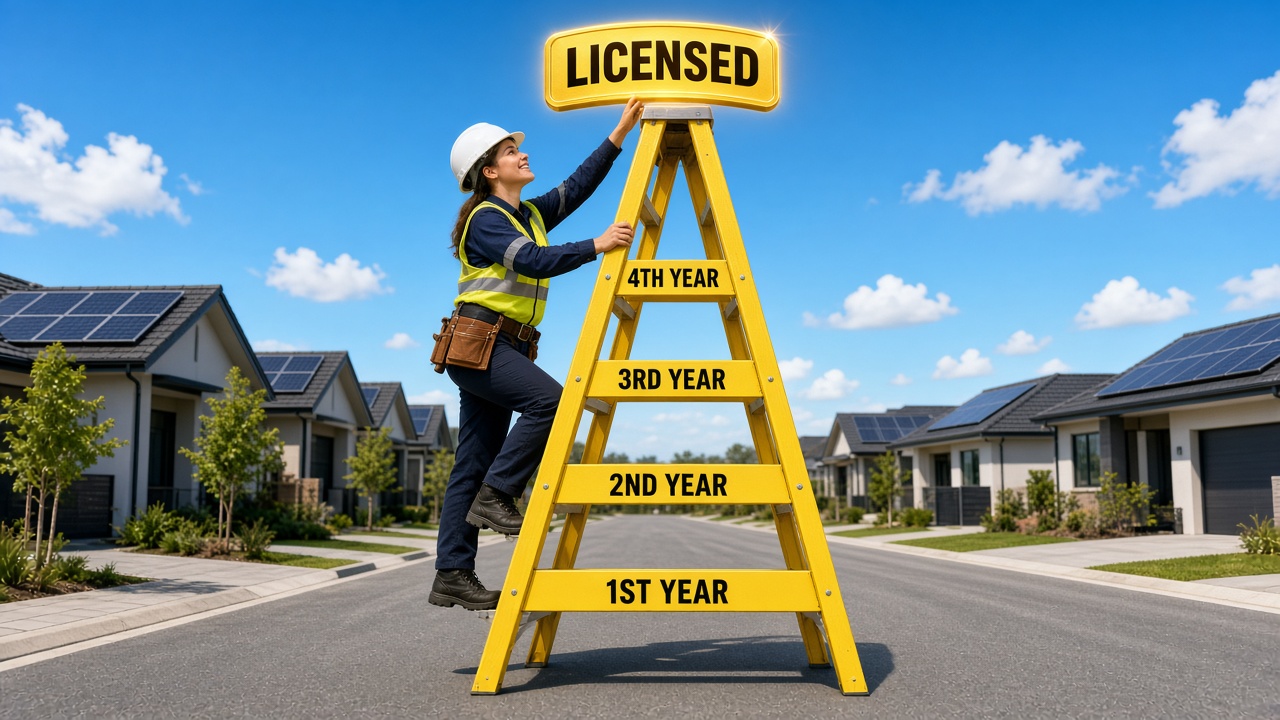
Apprentice minimum rates are set by the Electrical, Electronic and Communications Contracting Award as a percentage of the electrician (Electrical worker grade 5) rate. From the first full pay period on or after 1 July 2026, the minimum ordinary hourly rates for a junior apprentice (not on shiftwork) who started on or after 1 January 2014 are:
- 1st year: $17.97 an hour if you've completed Year 12, or $16.39 if you haven't
- 2nd year: $21.13 with Year 12, or $19.55 without
- 3rd year: $22.71
- 4th year: $26.50
Those rates include the industry, tool and electrician's licence allowances that the award pays for all purposes. Adult apprentices get more: for someone who started on or after 1 January 2014, the award's adult apprentice rate is $25.87 an hour in first year and $28.90 from second year. And if you were already working for an employer for at least six months full-time before starting your adult apprenticeship with them, the award says your minimum wage can't go backwards.
Two things to keep in mind. These are minimums, and plenty of employers pay more. One Sydney contractor advertising for a second-year apprentice this week listed $65,000 a year. And overtime, site allowances and travel can lift take-home pay a lot, especially in commercial and industrial work. Always check the Fair Work Ombudsman's pay calculator or your enterprise agreement for your exact situation.
The government support most apprentices don't know about
This is the bit I really want school leavers and career changers to read. According to Australian Apprenticeships, eligible apprentices can get:
- Key Apprenticeship Program (KAP) Apprentice Incentive: if you're training in the clean energy or housing construction sectors, up to $10,000 for full-time apprentices (or $5,000 part-time), paid as $2,000 at 6, 12, 24 and 36 months and on completion.
- Australian Apprentice Training Support Payment: up to $2,500 if you're training in an occupation on the Australian Apprenticeship Priority List, paid as $625 at 6, 12, 18 and 24 months for full-time apprentices.
- Australian Apprenticeship Support Loans: an interest-free loan of up to $27,048 (2026-27) for priority-list qualifications, paid monthly. You don't repay until you earn above $69,528, and you get a 20% discount on the loan when you complete.
Eligibility has rules, so use the Apprenticeships Incentives Explorer or ask your Apprentice Connect Australia Provider. But for an eligible full-time apprentice in clean energy, that KAP payment alone is up to $10,000 on top of wages. That's real money in the tight first years Emma talked about.
Demand is strong, and getting stronger
More young Australians are picking up the tools. National Centre for Vocational Education Research figures, cited by Energy Matters, show electrician apprenticeship commencements rose 19% in the March quarter of 2026 compared with a year earlier, to 6,870.
That's great news, but it's still not enough. Australia needs tens of thousands more energy tradies by 2030 to build the solar farms, batteries, transmission lines, data centres and homes on the drawing board (we covered the numbers in Australia needs 42,000 more energy tradies).
You can see the breadth of opportunity in the apprentice ads posted on Indeed over the past week:
- CBRE is advertising an electrical apprentice role in a data centre in Melbourne.
- Veolia wants an electrical apprentice at Tomago in the Hunter.
- PHE is recruiting first-year electrical apprentices in Bathurst.
- O'Brien Glass is advertising for second- and fourth-year apprentices in Victoria.
- SODHI Electrical in Perth is hiring trade assistants and apprentices for an immediate start.
Data centres, water and waste, regional towns, manufacturing and suburban contracting. It's a long way from the old picture of an apprentice holding a ladder.
How it works in New Zealand
Kiwi apprentices follow a similar model. Under the EWRB's qualified pathway, you complete an apprenticeship through one of the Board-recognised industry training organisations and gain an approved qualification, then apply for registration.
The EWRB's experience pathway shows what the Board expects of an electrician: passing the Electricians Theory and Electricians Regulations coursework and written exams, completing the stage 1, 2 and 3 practical assessments, four years (8,000 hours) of practical training and experience, approved safety training and a competence programme course. In other words, it's a proper four-year trade on both sides of the Tasman, and the skills translate well if you want to work in Australia later.
How I'd land an electrical apprenticeship
Here's what I'd do if I were 17 again, or 35 and ready for a change:
- Do a pre-apprenticeship if you can. A short pre-vocational electrical course shows employers you're serious and teaches you the basics before day one.
- Keep up your maths. Calculations are a big part of trade school and the capstone. Year 12 also lifts your first-year award rate.
- Get your driver's licence. So many apprentice ads ask for it, because you'll be travelling between sites.
- Approach small contractors directly. Lots of local sparkies never advertise. A neat one-page CV, a phone call and turning up on time to meet them goes a long way.
- Look at group training organisations. They employ apprentices and place them with host employers, which can be a great way in if you don't have contacts.
- Think about where the work is going. Solar, batteries, EV charging, data centres and the grid are all growing fast. Apprentices who get exposure to them early come out with a head start.
- Ask about the incentives. Check what you're eligible for before you sign, and make sure your employer registers you properly through an Apprentice Connect provider.
Is it worth it?
I think it's one of the best career decisions a young person can make right now. You earn while you learn, you finish without uni debt, and you step into a trade that the whole energy transition depends on. Emma's right that the first year or two are tight. But four years later you're a licensed electrician, and every door in this industry is open to you, from solar farms and data centres to running your own business.
Ready to start? Browse the latest electrical apprentice and electrician jobs across Australia and New Zealand, and set up a job alert so the right opportunity finds you.