Summer-Ready Grid: 6 GW of Batteries and NZ's Biggest Solar Farm
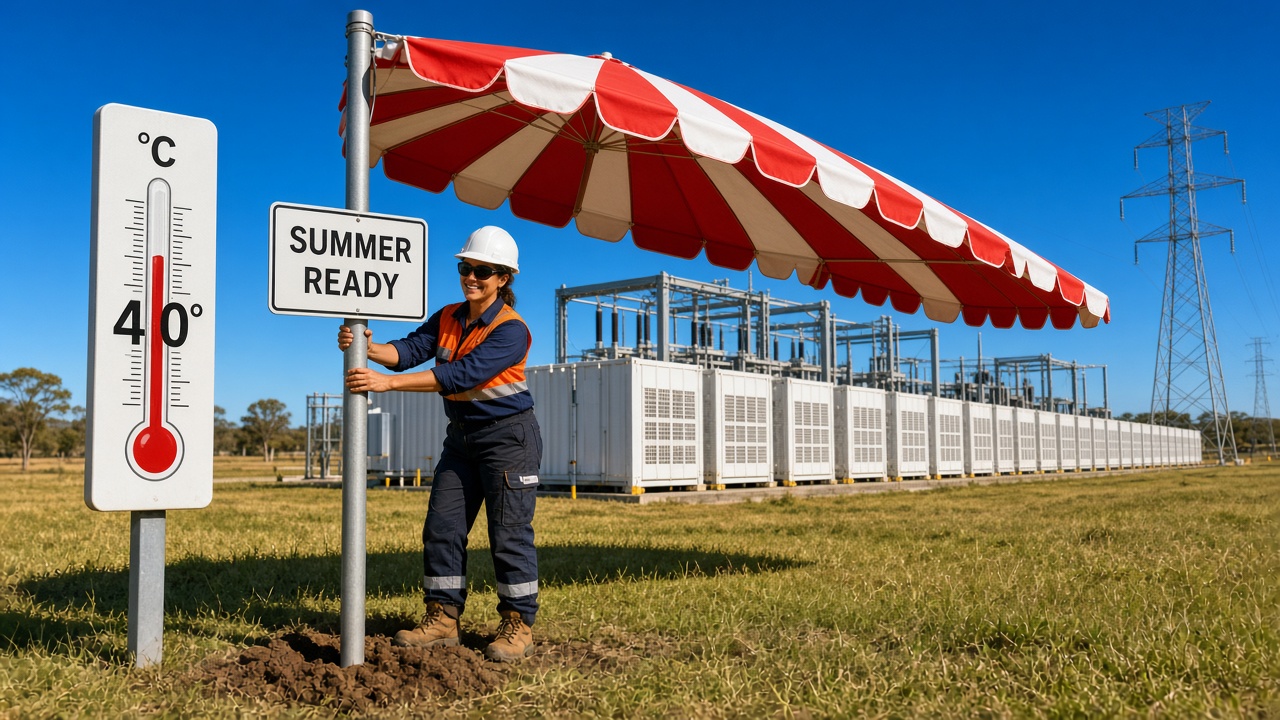
AEMO says 6 GW of new big batteries will get us through a hot summer, Tomago and HumeLink power on, SA backs strata solar and NZ opens its biggest solar farm.
Summer's nearly here, and for once the big energy story going into it is a good one. On Friday the Australian Energy Market Operator said, in short, that we've built enough new batteries to get through what's shaping up as a scorcher. In the same week, the biggest battery in NSW hit a major milestone, two huge transmission projects ticked off tower counts, South Australia opened the door to solar and batteries for apartment dwellers, and New Zealand officially opened its largest solar farm.
Every one of those stories is work for electricians, so here's what happened and what I'd do about it.
AEMO: the batteries have our back this summer
AEMO's 2026-27 Summer Readiness outlook, published on Friday 20 November and reported by Renew Economy, expects electricity and gas supplies to be sufficient, even with a warmer and drier than average season and an El Niño stretching into autumn.
The reason for the confidence is the build. Since December 2025:
- The National Electricity Market (NEM) has added 5.3 GW of battery storage, plus 1.1 GW of solar, 0.7 GW of wind, 0.7 GW of gas and 0.5 GW of hybrid solar and battery capacity.
- On WA's main grid, three batteries totalling 600 MW have reached full output.
- Behind the meter, federal energy minister Chris Bowen said last week that more than 600,000 home batteries installed under the Cheaper Home Batteries program now add up to 16.6 GWh of combined storage.
AEMO's executive general manager of operations, Michael Gatt, kept it real: "Electricity and gas supplies are expected to remain sufficient under forecast conditions this summer, but we know conditions can change quickly, particularly during periods of extreme heat."
AEMO also says the summer is likely to rank among the hottest 20% on record and could set new maximum demand records in both the NEM and WA. Gatt pointed to one challenge that I think is a genuine opportunity for our trade: the "limited real-time visibility of residential batteries and electric vehicles", which makes forecasting harder.
Here's my take. Two years ago the summer conversation was all about whether old coal units would hold up. Now it's about how millions of batteries, big and small, behave on a 40-degree evening. That's a much better problem to have, and it puts electricians right in the middle of the solution. Batteries that are commissioned properly, set up with the right settings and connected to monitoring are batteries the grid can count on. If you install home batteries, summer is a great time to call past customers, check their systems are online and reporting, and make sure their settings suit their tariff. It's good service, and it's good for the grid.
Tomago battery: 100 units down, 300-odd to go
In the Hunter, AGL marked the installation of the first 100 battery units at its Tomago battery on Wednesday 18 November. It's a 500 MW, four-hour system (2,000 MWh) going in next door to the Tomago aluminium smelter, with an $800 million price tag and Fluence as the main supplier and builder.
The progress report reads like a commissioning electrician's to-do list: concrete foundations laid, 100 of more than 400 battery units installed, work on the substation well advanced, and the first of two main transformers delivered the week before. Construction is employing more than 200 workers, and AGL says it's on track for completion in late 2027.
"The installation of the first batch of 100 battery units is an important milestone as we work to deliver the 500-megawatt Tomago Battery on schedule in late 2027," said AGL general manager Johan Myburgh.
What I love about Tomago is the cost story. Renew Economy notes it has cost AGL only a little more than its $750 million Liddell battery while storing twice as much energy. When storage keeps getting cheaper, more of it gets built, and that's a long runway of work for HV, substation and commissioning crews in the Hunter.
Transmission: 100 towers up in Central-West Orana, 157 on HumeLink East
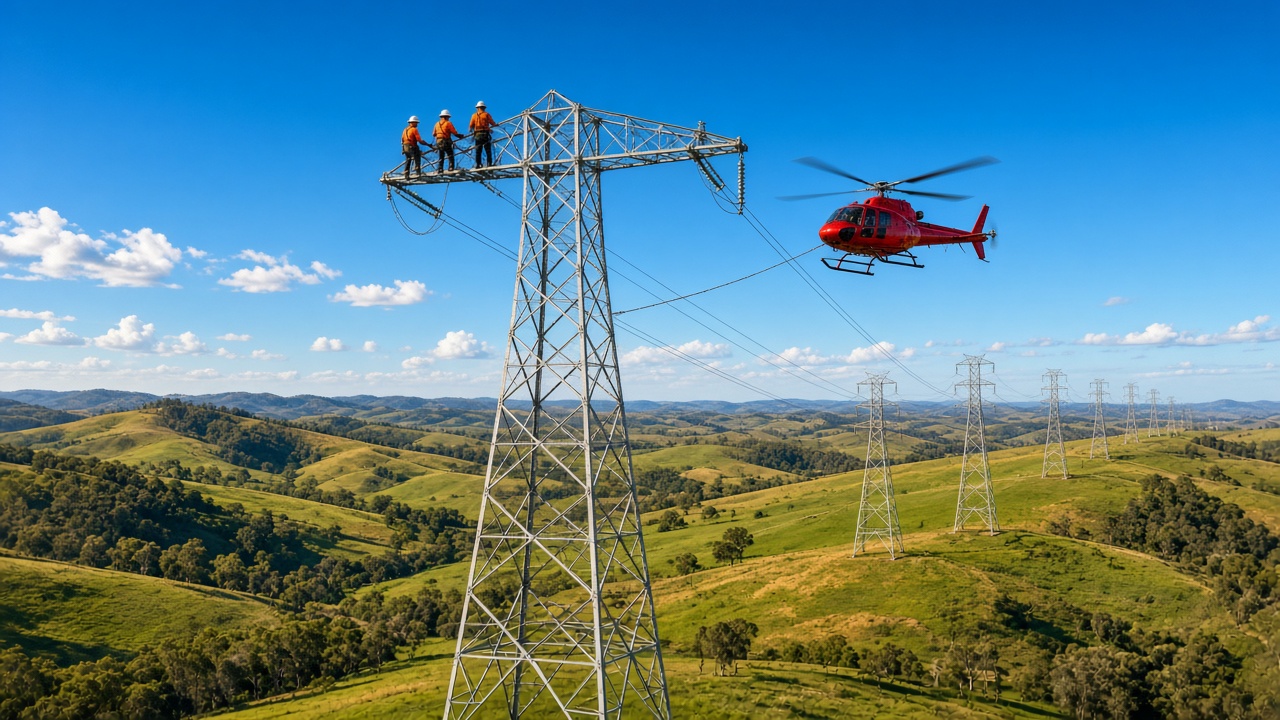
Out west, the ACEREZ consortium (Acciona, Cobra and Endeavour Energy) has raised the 100th transmission tower in the Central-West Orana Renewable Energy Zone. The milestone tower is a 70-metre, 48-tonne double-circuit steel lattice tower that will carry two 500 kV circuits. The REZ network will include 90 km of 500 kV and 150 km of 330 kV lines.
"We have 100 towers raised, stringing is underway and work at our energy hubs is well advanced," said ACEREZ CEO Steve Masters, with energy delivery to homes and businesses planned from 2028.
A week earlier, Acciona and Genus passed one year of construction on HumeLink East for Transgrid: 225 km of 500 kV line from Bannaby to Wondalga, plus an upgrade of the Bannaby 500 kV substation. They've built 382 tower pads, finished more than 70% of the foundations and installed 157 towers, with the 200th expected in the coming weeks. Commissioning of new electrical equipment at Bannaby is already under way, and the crews are moving on to stringing more than 6,000 km of conductor, by helicopter.
If you've ever wanted to work on something you can point to from a plane window, this is it. Lineworkers, substation electricians, protection technicians and commissioning crews are all needed. Our guides to the substation electrician, protection technician and lineworker roles explain how to get in.
South Australia opens up solar and batteries for apartments
This one is quietly huge for residential sparkies. The federal and South Australian governments have announced a $17.8 million package for shared solar and batteries in strata buildings, delivered through the state's new StrataCharge program with Brighte Capital.
The key details:
- The federal government is putting in $8.9 million from its Community Solar Banks program for grants covering up to 50% of the cost of a shared solar and battery system, up to $47,500.
- The Clean Energy Finance Corporation's Household Energy Upgrades Fund backs optional zero-interest loans for the rest, also up to $47,500.
- An estimated 160,000 SA households, about one in every 12 residents, live in strata and community titled properties.
- Brighte will support applicants and connect them with its existing accredited installer network.
Strata jobs have always been the hard nut of residential solar. Shared roofs, common property, body corporate approvals and the question of who gets the savings have stalled plenty of projects. A program that covers the whole cost and comes with hand-holding on the governance side changes that. If you're an SA contractor with commercial solar and battery experience, I'd be getting across the StrataCharge details now. Strata systems are bigger than a typical home install, they need neat, well-documented work on common property, and they're a great way to build a reputation with property managers who look after dozens of buildings.
New Zealand opens its biggest solar farm
Across the Tasman, the Tauhei Solar Farm near Te Aroha was officially opened on Thursday 19 November, making it the largest operating solar farm in New Zealand (for now, as the Waikato Times nicely put it).
The numbers:
- 202 MW peak capacity and about 280 GWh a year, roughly the annual use of 35,000 homes.
- About 330,000 panels, connected through a 140-tonne transformer and a 4 km line to Transpower's Waihou substation.
- Spanish contractor Elecnor led construction, and Harmony Energy says the project provided about 151 full-time on-site jobs over its 18-month build, with more than 285 workers on site at its peak, many from Te Aroha, Matamata and Morrinsville.
- Meridian Energy is buying the output for the first 10 years, and the site doubles as a sheep farm, with 900 sheep already grazing under the panels.
I love the local jobs angle. Big solar farms are bringing construction and electrical work to rural towns, and the crews who build them walk away with utility-scale experience that's in demand on both sides of the Tasman.
NZ's regulator is also clearing the way for more storage. The Electricity Authority has confirmed that from March 2028 battery owners will be able to trade their full capacity and submit offers with up to 10 price bands, compared with five for other generators. Better market rules mean better business cases, and better business cases mean more batteries to build.
And a fun one to finish: in Queenstown, two local businesses are now hiring out portable battery power to film sets, weddings and festivals as a quiet alternative to diesel generators. NRG Event Batteries says its kit is built in Central Otago by industrial electricians and event technicians, and newcomer Gen B runs 80 kWh trailer-mounted batteries plus electric utes with vehicle-to-load. That's what I mean by the electrification opportunity being bigger than the obvious jobs.
What I'd do this week
If I were a sparky or contractor in Australia or New Zealand right now:
- Get summer-ready with your battery customers. Check systems are online, firmware is current and settings suit the customer. It builds trust and repeat work.
- Look at the big builds. Tomago, HumeLink East and Central-West Orana are hiring through contractors right now for HV, substation, stringing and commissioning work.
- SA contractors, look at strata. StrataCharge removes the biggest barrier to apartment solar, which is money.
- Kiwis, follow the solar pipeline. Tauhei is the biggest so far, but it won't be for long.
The grid is getting stronger every month, and electricians are the ones building it. When you're ready for your next move, browse the latest electrical jobs across Australia and New Zealand.