
What Does a Protection Technician Do? Pay and Pathways

Protection technicians test the relays that keep the grid safe. What they do, what they earn in Australia and NZ, and how sparkies move into protection.
When a fault hits the grid, something has to notice it and act in a fraction of a second. A tree branch touches a line, a cable fails underground, a transformer develops an internal fault, and within milliseconds a relay detects it, trips the right circuit breaker and isolates the problem while everything else stays on. Most people never know it happened.
The person who makes sure that split-second decision is the right one is the protection technician. In this edition of our role explainer series, I want to shine a light on one of the most underrated jobs in the electrical world: what protection technicians actually do in Australia and New Zealand, what they earn, how sparkies move into it, and why I think it's one of the smartest career moves in the trade right now.
What a protection technician actually does
Protection technicians (you'll also see "protection and control technician", "secondary systems technician" or "protection tester") work on the brains of the power system rather than the brawn. Lineworkers and substation electricians handle the primary plant: the lines, transformers, switchgear and cables carrying the power. Protection techs look after the secondary systems that monitor that plant and tell it what to do.
Transgrid's current Protection Technician ad puts it beautifully: you work on "the systems that detect faults and respond in milliseconds, protecting people, critical assets and the stability of the wider power system." The listed duties give a real feel for the job:
- maintaining, testing and fault-finding protection relays and schemes, "from electromechanical equipment to modern numerical relays"
- supporting installation and commissioning across transmission lines, transformers, reactors, busbars and circuit breaker fail schemes
- revenue, check and statistical metering
- interpreting schematics, diagnostic testing and contributing to safe switching, isolations and protection withdrawal.
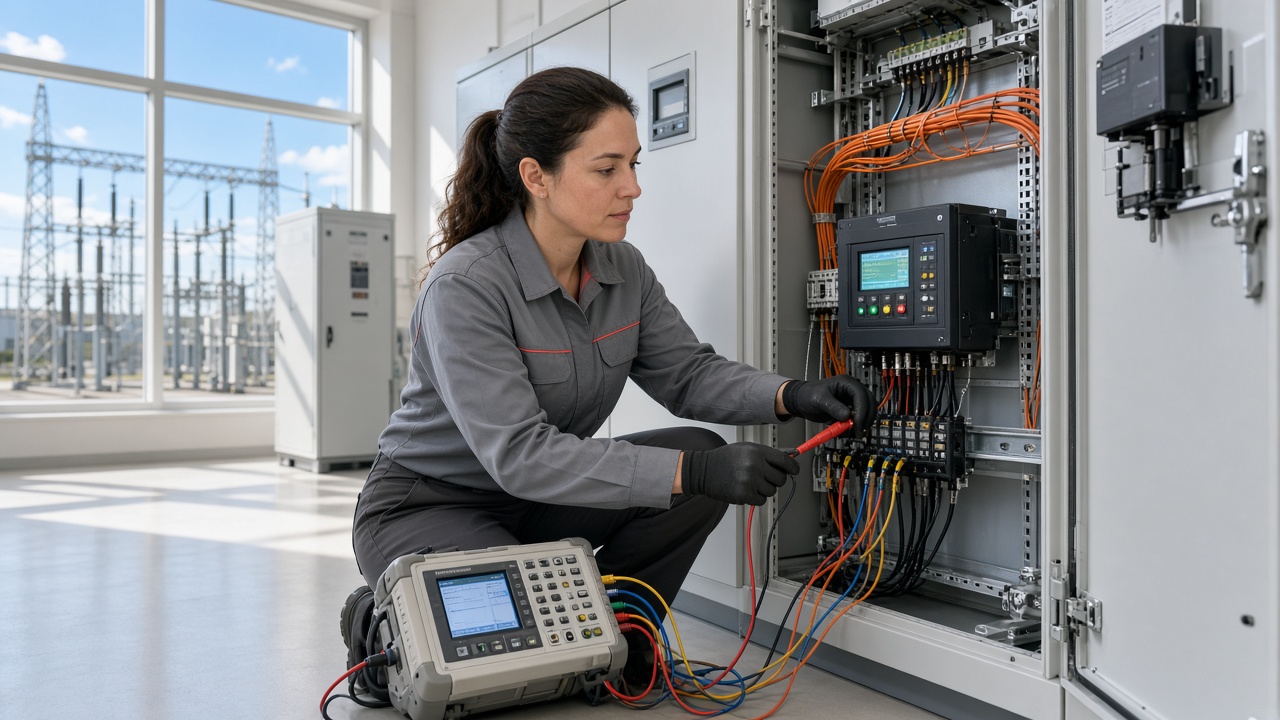
A typical day might start with a permit and isolation at a zone substation, then hours of secondary injection testing: using a test set to inject precisely controlled currents and voltages into a relay to prove it trips exactly when, and only when, it should. You'll check CTs and VTs, confirm the settings file matches what's actually loaded, test the trip circuits through to the breaker, and document everything. Some days it's a brand new substation being commissioned. Other days it's chasing an intermittent fault in a 40-year-old scheme with hand-drawn schematics.
The kit is serious. Monadelphous, which posted a Protection Technician role on 17 November for Sydney and the Central Coast, lists Omicron test equipment including the CMC356, CPC100 and CT Analyser, plus feeder, transformer and generator protection schemes. Downer's Substation Protection & Control Tester role in Dandenong names differential, distance, overcurrent and earth fault protection, plus SCADA and RTUs, across zone substations, transmission substations and utility-owned data centre substations.
And then there's IEC 61850, the digital substation standard that replaces kilometres of copper control wiring with fibre and networked messaging. Transgrid explicitly mentions building capability in "emerging technologies such as IEC 61850". If you like the idea of being part sparky, part network engineer, this is where the role is heading.
Where protection techs work
The big employers fall into a few groups:
- Transmission and distribution networks such as Transgrid, Ausgrid, Energy Queensland, Western Power, TasNetworks, Transpower and the NZ lines companies, maintaining and upgrading their own substations.
- Contractors and service providers such as Monadelphous, Downer and specialist testing firms that commission new substations and do maintenance for networks.
- Renewables and battery projects. Every solar farm, wind farm and big battery has a substation and a protection scheme that must be commissioned and tested before it can connect.
- Data centres, mines and heavy industry, which run their own HV networks and need their protection proven and maintained.
That last group is getting bigger fast. The AEMC's new rule, effective 12 November, requires data centres and other inverter-based loads of 30 MW or more to ride through grid disturbances rather than disconnecting unnecessarily. Proving that kind of performance is exactly the territory where protection and commissioning skills shine.
What protection technicians earn in Australia
Pay is strong, and the packages often come with very good extras. Here's what's being advertised right now:
- Ausgrid advertised a Protection Technician in Muswellbrook this month at $98,000 to $117,000 plus 16.5% super, relevant allowances and overtime potential, with a work vehicle and tools provided and a fortnightly RDO. The role covers maintenance and commissioning of protection, automation and control equipment in distribution, zone and sub-transmission substations.
- Transgrid is hiring Protection and Metering Technicians across Greater Sydney (Eastern Creek), Newcastle, Yass, Wagga Wagga, Tamworth and Orange, with 16.5% super, a company vehicle, a fortnightly RDO, field and general-purpose allowances and 20 weeks' paid parental leave. Pay depends on the grade you're assessed at. Applications close 30 November 2026.
- An EPC contractor role advertised through People8 in Sydney earlier this year offered $95,000 to $120,000 for an experienced protection and control technician working across 11 kV to 330 kV.
As always, advertised ranges are a guide, not a guarantee, and on-call, overtime and allowances can add a lot on top of base. Notice that 16.5% super figure, too. Compared with the standard 12% superannuation guarantee, that's a meaningful bump every year.
The progression is where it gets really interesting. Many protection techs move on into protection engineering, and SEEK's Protection Engineer salary page currently shows average advertised salaries of around $194,000 across Brisbane and regional Queensland. That's a career ladder worth climbing.
And in New Zealand
Tahatū Career Navigator lists "power systems technician" and "metering technician" under its electrical and electronic engineering technician profile, with most people earning NZ$63,000 to NZ$107,000 and the top end around NZ$144,000.
Demand is building. Transpower's new engineering design panel, starting on 1 January 2027, explicitly covers "protection and automation" alongside substations and lines, and Transpower expects electricity demand to rise 80% by 2050. More design work flows into more commissioning and testing work. If you've read our power technician explainer, protection is one of the most natural specialisations to grow into.
How to become a protection technician
Here's the encouraging bit: you don't need an engineering degree. Most employers want a trade first.
- Get your electrical trade. Ausgrid and Transgrid both ask for a Certificate III in Electrotechnology or an equivalent electrical trade qualification. A licence and some HV or industrial experience make you a much stronger candidate.
- Get comfortable with schematics. Both Ausgrid and Transgrid list reading electrical drawings and schematics as a core requirement. If you can trace a trip circuit on paper, you're halfway there.
- Build the formal qualification. The UET60222 Advanced Diploma of ESI – Power Systems has a dedicated Protection (Testing) specialisation covering commissioning, maintaining and diagnosing faults in complex protection and control systems, plus a Protection and Metering (Testing) stream. There's also a unit of competency, UETDRIS033 Solve problems in network protection. Some employers, including Monadelphous in its current ad, want a diploma or advanced diploma for experienced roles.
- Look for "we'll train you" roles. Transgrid says it's recruiting "from qualified electrical tradespeople ready to move into protection through to experienced protection professionals", with practical training across protection, metering and secondary systems. Ausgrid describes its role as a potential pathway into its Protection Automation and Control roles. These are genuine on-ramps.
- Learn the test gear and the digital future. Get hands-on with relay test sets whenever you can, and start reading up on IEC 61850 and SCADA. Those are the skills that will separate good protection techs from great ones over the next decade.
Is it right for you?
I'd say protection suits a particular kind of sparky. You enjoy the why as much as the how. You're methodical, you like solving puzzles, and you get satisfaction from proving something works rather than just installing it. You don't mind a bit of travel (regional substations are a big part of the job) and you're happy to keep learning, because the technology never stands still.
The trade-offs are real: on-call rosters, early starts, and a level of responsibility that comes with knowing your test results are what keeps a substation safe. But that responsibility is exactly why the role is respected and well paid.
Why now is a brilliant time
Australia and New Zealand are building more substations than at any point in a generation. Renewable energy zones, big batteries, interconnectors, data centres and electrified industry all need protection schemes designed, installed, tested and maintained for decades. Every one of those projects is a job for a protection technician, and there simply aren't enough of them.
If you're a licensed electrician who loves fault-finding and wants a specialist career with a clear path up, protection is one of the best moves you can make. Browse the latest electrical jobs across Australia and New Zealand, including protection, substation and commissioning roles, and take your next step.