
How to Get Your Electrical Licence in Australia (and Work in NZ)

How to get your electrical licence in Australia: UEE30820, final assessments, state regulators, contractor licences, AMR, moving to NZ via TTMRA, and real pay.
An electrical licence is one of the most valuable pieces of plastic you'll ever carry. It turns four years of hard graft into a career you can take almost anywhere: residential, commercial, mining, data centres, renewables, and even across the Tasman to New Zealand. But the path to getting one is surprisingly confusing, because every state runs its own regulator with its own rules and its own names for things.
So let's cut through it. Here's how the licence actually works in Australia right now, how to move between states and into New Zealand, what overseas electricians need to do, and what the pay looks like once you're through. I'll keep it practical, and I'll link the official sources so you can check the fine print for your state.
Step one: the apprenticeship and UEE30820
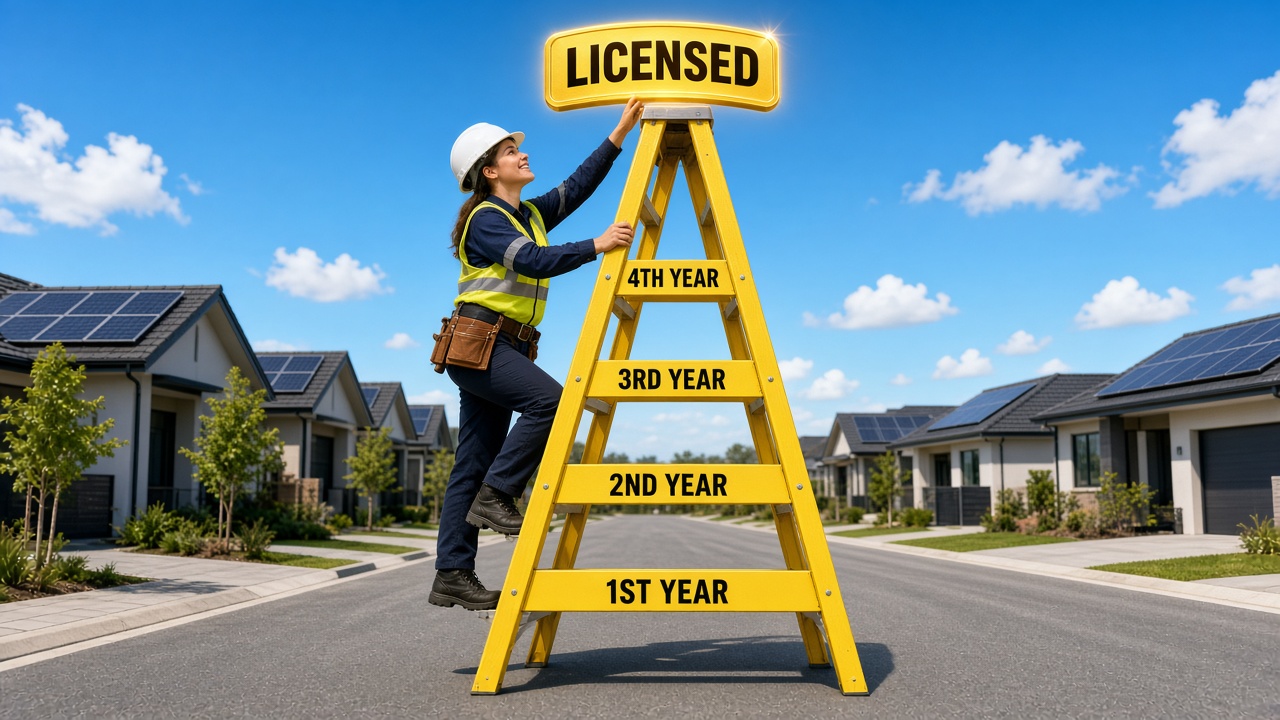
The foundation everywhere is the UEE30820 Certificate III in Electrotechnology Electrician. It's the national qualification that covers selecting, installing, testing, fault-finding and maintaining electrical systems in buildings, and it's built around the Essential Performance Capabilities that regulators expect for an unrestricted electrician's licence. The qualification document is blunt about one thing: to get an unrestricted licence in most jurisdictions, the Cert III must be completed as an apprenticeship or through the Trades Recognition Australia (TRA) pathway. You can't just do a short course and walk out a sparky.
Expect four years. In Victoria, for example, Energy Safe Victoria's apprentice pathway requires a completed four-year contract of training that includes at least 12 months of electrical installation work, confirmed in writing by your employer. That 12 months of real installation work is a theme you'll see in most states, so if your employer has you on maintenance or panel work only, raise it early. It's your licence on the line, not theirs.
A nice sign of the times: the core of UEE30820 now includes a unit on identifying, shutting down and restarting systems with alternate supplies. Solar and batteries aren't a niche any more; they're baked into the trade.
Step two: the final licensing assessment
Finishing your Cert III isn't the finish line. Most states put a final, independent check between you and your licence, and that's where a lot of apprentices get caught out.
In Victoria, it's the Licensed Electrician's Assessment (LEA), run by assessment centres approved by Energy Safe. It has three parts: Safe Working Practice, Licensed Electrician's Theory and Licensed Electrician's Practical. You also need a completion letter from the Victorian Registration and Qualifications Authority, and your LEA must be completed within five years of applying.
In NSW, the standard route through Building Commission NSW needs the completed UEE30820, a certificate of proficiency from the Vocational Training Review Panel, and at least 12 months of relevant wiring experience using AS/NZS 3000:2018, backed by a referee's statement. NSW may also test your knowledge of the current wiring rules, and you'll need a National Police Check no older than four months. (If you've got older, superseded qualifications, some NSW pathways require the 6077AC Capstone Assessment or a TAFE Digital wiring rules re-licensing assessment.)
In Queensland, licensing runs through the Electrical Safety Office at WorkSafe Queensland, and Business Queensland lists six types of electrical work licence, with the electrical mechanic licence authorising all electrical work.
My advice: don't treat the final assessment as a formality. Book practice sessions, know your testing sequence cold, and revise AS/NZS 3000. It's the one exam where nerves really cost people.

Restricted, unrestricted and contractor licences
Not every licence lets you do everything. An unrestricted licence (A-grade in Victoria, electrical mechanic in Queensland) covers general electrical installation work. Restricted licences cover a narrower scope, such as disconnecting and reconnecting appliances or air-conditioning and refrigeration work. Queensland, for example, has a separate restricted electrical work licence, and Victoria has a Restricted Electrical Worker licence.
The other big distinction trips up plenty of newly licensed sparkies: being licensed to do the work isn't the same as being licensed to contract for it. Energy Safe Victoria is clear that an A-grade licence lets you work as an employee, but to do electrical work for profit or reward you must also be a Registered Electrical Contractor (REC). Queensland has unrestricted and restricted electrical contractor licences. NSW offers individual contractor licences, company or partnership contractor licences, and qualified supervisor certificates, issued for one, three or five years. NSW also takes unlicensed work seriously: fines of $22,000 for individuals and $110,000 for companies.
If you're thinking of going out on your own, line up the contractor licence, insurance and business basics before you quote your first job. Plenty of great sparkies have learned that lesson the expensive way.
Working interstate: AMR and the East Coast scheme
Here's some genuinely good news. Thanks to Automatic Mutual Recognition (AMR), licensed electrical workers from participating states can work in other participating states without getting a whole new licence. According to Energy Safe Victoria, every state and territory except Queensland now participates in AMR for electrical licences. In most cases you still need to notify the regulator in the second state before you start, and if you move there permanently you'll generally need to apply for a local licence.
Queensland is the odd one out, but there are workarounds. Victoria lets Queensland electricians with an A-grade-equivalent licence work under exemption provisions after notifying Energy Safe. And NSW runs an East Coast Electrician's scheme where electricians from Queensland, Victoria and the ACT are automatically recognised for electrical wiring work without notifying the regulator. For FIFO workers and anyone chasing big projects across borders, that flexibility is gold.
Moving to New Zealand under the TTMRA
Fancy working in New Zealand? The Trans-Tasman Mutual Recognition Arrangement makes it straightforward if you already hold a current Australian licence. New Zealand's Electrical Workers Registration Board (EWRB) converts an equivalent Australian licence into an NZ registration and practising licence. An unrestricted electrician licence from NSW, Victoria, WA, Tasmania or the ACT, or a Queensland or NT electrical mechanic licence, maps to the NZ "Electrician" class.
The key catch: the EWRB recognises Australian licences, not Australian qualifications. Finish your licensing first, then apply. You'll need certified ID, a certified colour copy of both sides of your licence, a certified Section 19 statutory declaration, a passport-quality photo and payment, and you'll want the practising licence because that's what lets you carry out prescribed electrical work in NZ. It works the other way too: Kiwi electricians can apply for recognition in Australia under the same arrangement.
Trained overseas? OTSR is your starting point
For electricians trained outside Australia and New Zealand, the route usually starts with TRA. The UEE30820 qualification itself names the TRA pathway as one of the two ways to qualify for an unrestricted licence. In Victoria, Energy Safe's international pathway asks for an Offshore Technical Skills Record (OTSR), or an Australian Technical Competency Statement if you've become a citizen. On top of that you need Australian-context gap training, the Cert III, a Supervised Worker's Licence, a score of 75% or higher in both the LET and LEP assessments, and 12 months of installation work under supervision. Other states differ in the detail, so check your target state's regulator before you book flights.
Apprentice incentives and the money
The government is actively paying people to join the energy workforce. Under the Key Apprenticeship Program's New Energy stream, eligible full-time apprentices who started or restarted on or after 1 July 2025 can receive up to $10,000: $2,000 at six, 12, 24 and 36 months and on completion. Your employer has to give you meaningful work in the clean energy sector. The broader incentive system changes from 1 January 2027, redirecting employer incentives towards small and medium businesses, so check the current rules when you sign up.
As for pay, the floor is set by the Electrical, Electronic and Communications Contracting Award. From 1 July 2026, an Electrical Worker Grade 5 (the qualified tradesperson level) gets a minimum of $29.45 an hour or $1,119.10 a week. Add an all-purpose industry allowance of $41.41 a week, plus an electrician's licence allowance of $40.29 a week if you hold and may need to use an unrestricted licence. Apprentices who started after 1 January 2014 earn a percentage of the Grade 5 rate: 50% (or 55% if you finished Year 12) in first year, rising to 82% in fourth year.
That's the minimum, and the market pays well above it. SEEK's electrician salary data for October 2026 shows average advertised salaries of $131,376 in mining, resources and energy, $94,807 in construction and $86,688 in trades and services, with Northern Queensland topping the location table at $127,500.
My practical advice
Pick an employer who'll give you broad installation experience, not just one narrow task. Keep a log of your work from day one. Treat the final assessment like a grand final. Once you're licensed, add a specialty that's booming, such as battery storage, data centres or high voltage. And keep New Zealand and interstate AMR in your back pocket; a licence that travels is a career with options.
Ready for your next step? Browse apprenticeships and licensed electrician jobs on ElectricalRoles across Australia and New Zealand.