
Power Sector Jobs Could Double: What Climate Analytics Means for Sparkies
Climate Analytics says Australia power-sector jobs could roughly double by 2035. What that means for sparkies, apprentices and regional hiring.
If you have been wondering whether the energy transition is "real work" for sparkies — the kind that pays, trains apprentices and keeps regional towns busy — a new Climate Analytics report lands with a clear answer: yes, and then some.
Published on 2 November 2026, Australia: opportunities for employment in a high renewable scenario models what happens to power-sector employment if Australia aligns its electricity system with a Paris-aligned fossil-fuel phase-out (FFPO) pathway. The headline for tradies is hard to ignore: annual labour demand in the national power sector roughly doubles.
The numbers, without the spin
Under the FFPO scenario, Climate Analytics finds power-sector employment rises from about 37,000 full-time equivalent (FTE) jobs in 2025 to roughly 76,000 in 2035 and about 87,000 by 2050, after a peak near 90,000 around 2030.
That is not a vague "green jobs" slogan. It is modelled labour demand across the electricity sector as renewables replace fossil generation, with construction and installation workers needed early as capacity is built out.
The same analysis contrasts that pathway with current-policy projections. In Climate Analytics' reading of current policies — even assuming existing renewable and climate targets are met — power-sector employment would only rise to around 51,000 FTE by 2050. It would climb to about 55,000 around 2030, then fall by roughly a third to around 35,000 by 2033, staying below the 2030 level until the late 2040s. The gap is the difference between a sharp build-out that keeps going, and a stop-start pathway that leaves workers and investors guessing after 2030.
In short: ambition creates steadier demand for the people who actually wire, install and commission the system. Uncertainty does the opposite.
What this means for sparkies on the tools
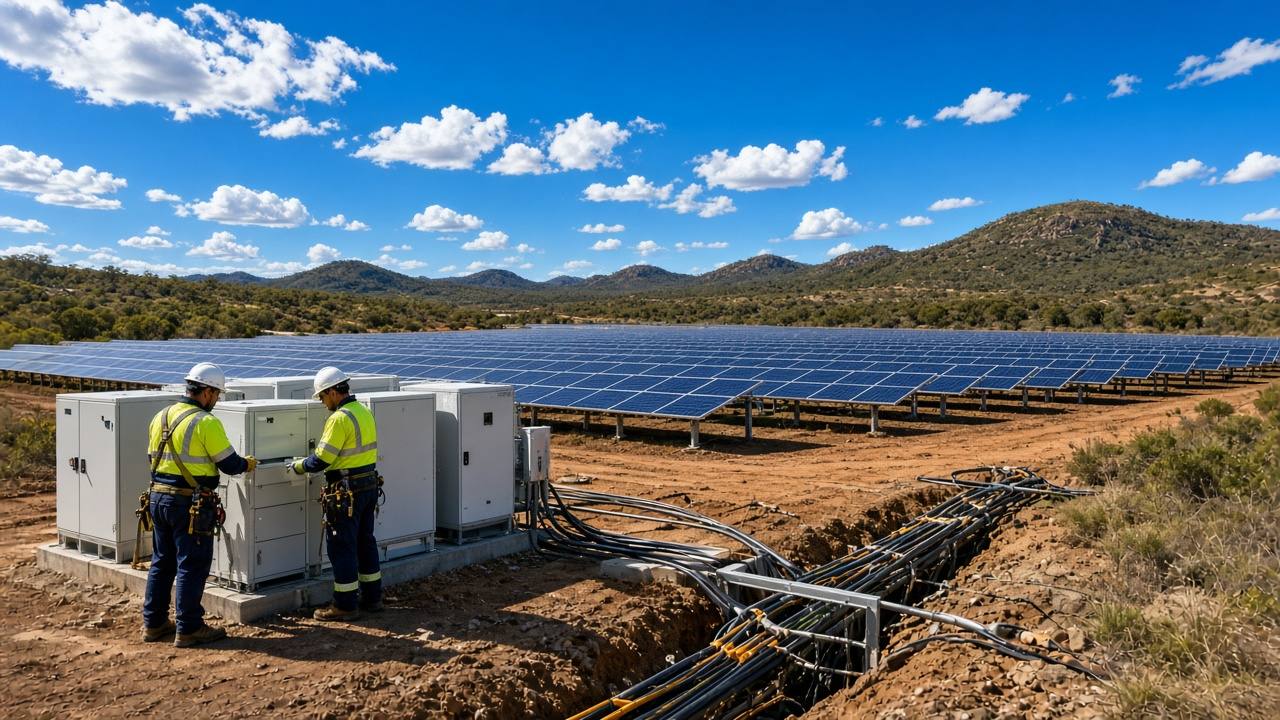
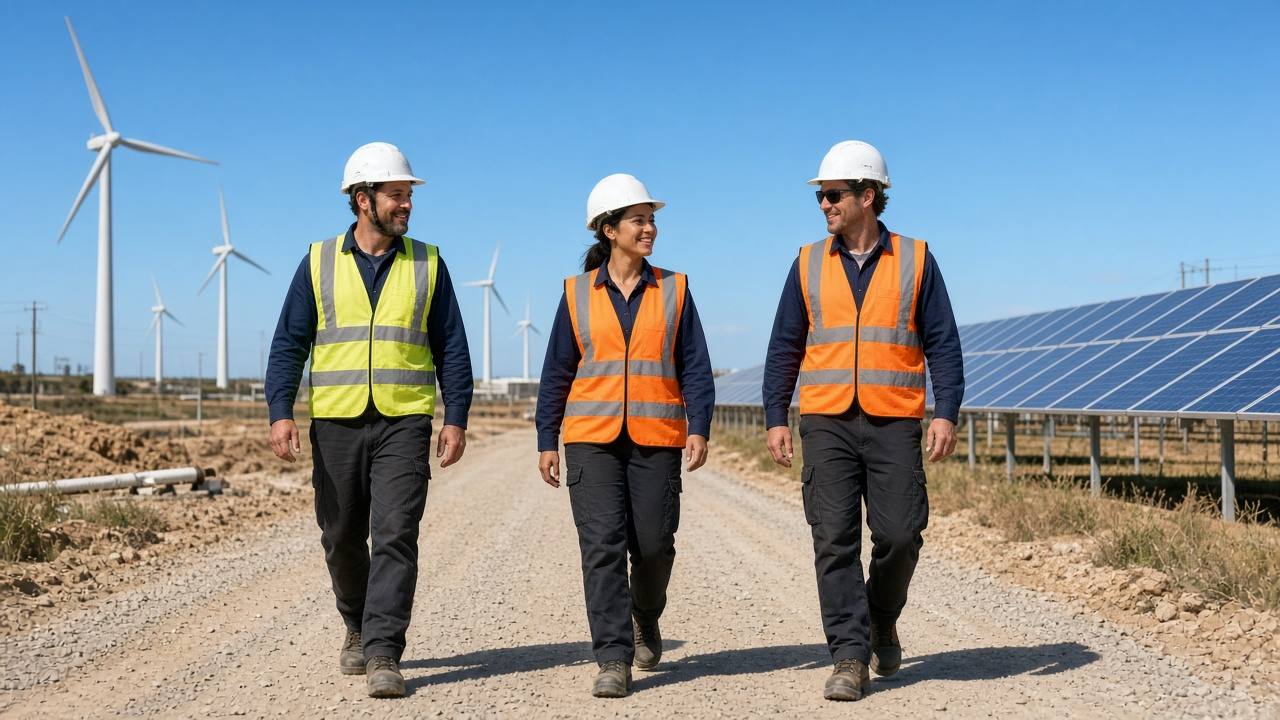
Electricians sit right in the middle of that labour curve. The early years of a high-renewables pathway are heavy on construction and installation — exactly the work licensed sparkies, apprentices, HV crews and commissioning techs already do on solar farms, wind projects, batteries, substations and grid connections.
Practically, that points to demand across several familiar lanes:
- Solar and wind construction — array cabling, turbine electrical fit-out, collection systems, switchrooms
- Battery energy storage — DC and AC side work, protection, commissioning
- High-voltage and substations — the kit that connects new generation to the grid
- Distribution upgrades — more electrification on the customer side means more switchboard, feeder and protection work in towns and suburbs
- Apprenticeships — a doubling of labour demand only sticks if the training pipeline keeps pace
The report also notes that by 2050, under the Paris-aligned pathway, the power sector would employ more than ten times as many FTE workers as legacy fossil generation does today. That is a structural shift in who the industry employs and where they work — not a one-season hiring blip.
Regional work, not just capital-city desks
One of the more useful findings for tradies is geography. Because renewable projects are decentralised, new jobs are spread around Australia — including regional areas and mining and industrial clusters that have sometimes lagged the transition on the east-coast main grids.
That matters if you are open to FIFO, DIDO or relocating for a few years of construction waves. It also matters for apprentices who want experience on large projects rather than only domestic work.
Climate Analytics is clear on the just-transition catch: new jobs will not always sit where fossil jobs leave. Active workforce planning is required so communities are not left waiting for work that lands two regions over. For individual sparkies, the practical read is simpler — stay mobile where you can, keep tickets current, and watch which renewable energy zones and industrial hubs are hiring now rather than waiting for a perfect local match.
New Zealand sits next door as an adjacent market rather than the focus of this particular report. Kiwi sparkies already see growing solar, battery and EV work; the Australian build-out still sets a lot of the tone for cross-Tasman contractors and OEMs. If you hold (or can get) the right practising licence, the same skills travel.
This is not only a 2035 story — hiring is happening now
Modelling is useful. Pay packets this month are better.
A live example: electricians are being recruited for the Solomon Airport Solar Farm near Tom Price in Western Australia, with Electrical W2 wave starts from 16 November 2026. Advertised packages sit around A$54 per hour plus penalties, with FIFO on a 2:1 roster from Perth and camp accommodation (Haynes People / Solar Jobs Australia). You need a WA-recognised electrical licence, White Card and driver's licence.
That is one project among many solar, wind and battery builds advertising through the spring and summer. The Climate Analytics curve says demand rises sharply through the late 2020s; the job boards already show the front edge of that wave.
Browse current electrical roles if you want to see what is live today across solar farms, batteries, HV and regional construction.
Practical steps if you want in
Stay optimistic, but be concrete. Here is a simple playbook:
- Keep your licence and tickets tight — state/territory electrical licence (or NZ EWRB practising licence), White Card, and any HV, switching or GWO tickets relevant to the work you want.
- Add renewables-facing skills — solar and battery accreditation, EV charging courses, commissioning experience. Employers hiring for the build-out want people who can land on site productive.
- Consider regional and FIFO waves — construction peaks are often away from the CBD. Rosters like 2:1 are common on remote solar and mining-adjacent projects.
- Watch apprenticeships and cadet pathways — if you are early career, the doubling of labour demand only works if apprentices come through; SEC-style academy pathways and contractor apprenticeships are part of the answer.
- Follow the project pipeline — renewable energy zones, big batteries and industrial electrification clusters are where multi-year work concentrates. Set job alerts and talk to labour-hire and EPC recruiters who cover those sites.
The optimistic read
Australia can choose a pathway where power-sector employment roughly doubles and stays elevated through mid-century — or one where hiring spikes then softens because targets and coal/gas retirement timelines stay fuzzy after 2030. Climate Analytics has put numbers on both stories.
For sparkies, the upside pathway is also the practical one: more solar, more wind, more batteries, more substations, more apprentices on the tools. The work is technical, regional and long-dated. If you like building things that still matter in 2040, this is your lane.
Check ElectricalRoles.com.au for openings, keep your tickets current, and treat the next few years as the moment to specialise — not the moment to wait and see.