Home Battery Boom Hits 15.3 GWh: What It Means for Sparkies
Cheaper Home Batteries hit 15.3 GWh. What the boom, the 2027 rebate step-down, CER inspection results and SAA accreditation mean for sparkies in AU and NZ.
If you want proof that Australian households have fallen hard for home batteries, here it is. The Cheaper Home Batteries Program hit 15.3 GWh of approved capacity by the end of September 2026, up from less than 2 GWh at the same point last year, according to new Clean Energy Regulator data released by Energy Minister Chris Bowen on 15 October. Capacity has more than tripled in 2026 alone, from 5.0 GWh at the end of 2025.
For sparkies, that isn't an abstract energy statistic. Every one of those batteries was designed, wired, labelled, tested and commissioned by a licensed electrician. It's one of the biggest pieces of residential electrical work this country has ever seen, and it's still running hot. Here's where the boom sits right now, what's changing, and why the next twelve months could be the best time yet to get battery-accredited, provided you do the work properly.
The numbers behind the boom
The program started on 1 July 2025 and gives households, small businesses and community groups a discount of around 30% on batteries between 5 kWh and 100 kWh connected to new or existing solar. In December 2025 the government expanded the budget from an original estimate of $2.3 billion to around $7.2 billion over four years, which it expects will see more than 2 million Australians install a battery by 2030.
The uptake has been relentless. The Clean Energy Council's latest Rooftop Solar and Storage Report counted 276,011 home batteries installed in the first half of 2026, up 52% on the previous six months. For every 100 rooftop solar systems installed, 153 batteries went in, which tells you how much of this is retrofit work on homes that already have panels. The program logged 457,439 installations and 12.9 GWh in its first year, and in August the Prime Minister and Energy Minister announced it had passed 507,000 installations.
And the momentum hasn't faded. Amber estimates Australians installed 966.5 MWh of home batteries in September 2026, up 12.5% on August and the strongest month since April. The government's own figures show another 1.9 GWh added in the September quarter.
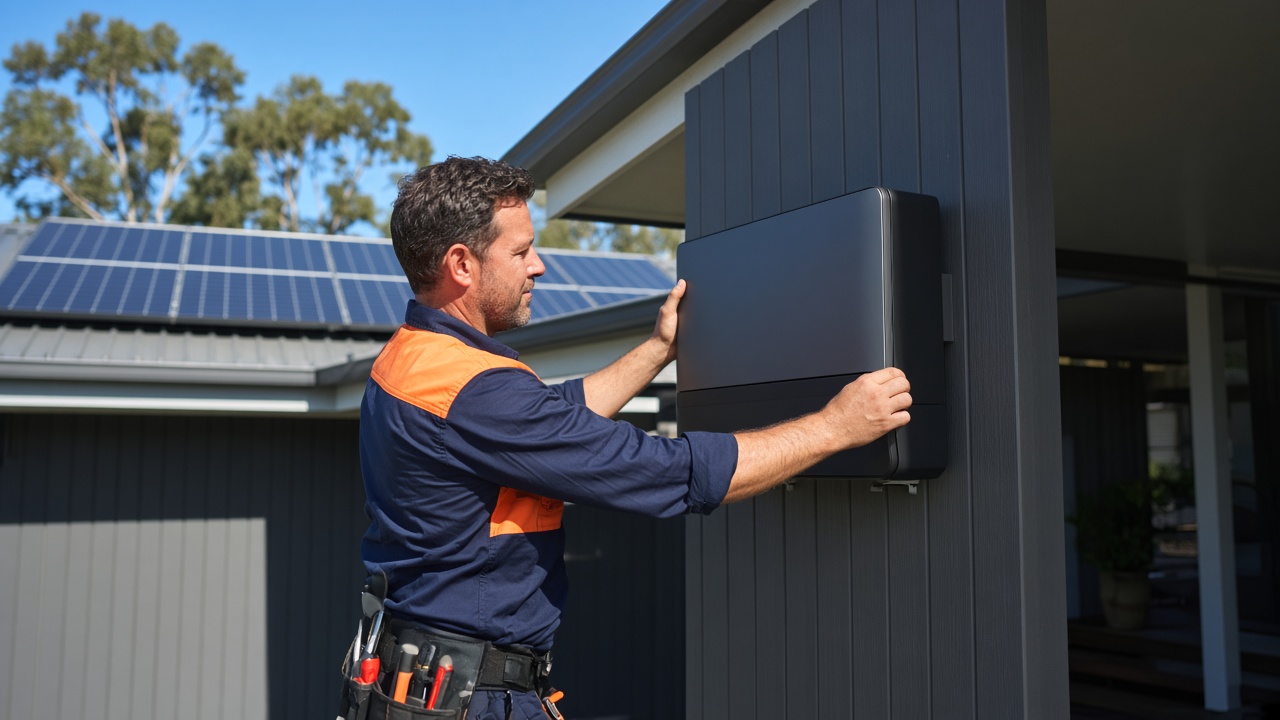
Geographically, NSW leads with 5.6 GWh of approved capacity, with Victoria and Queensland at about 3.2 GWh each. About half of approved installations are retrofits to existing solar and half go in alongside new or upgraded rooftop solar. That split matters if you're choosing where to specialise: retrofits are switchboard-heavy, brownfield jobs where good diagnosis and neat work win repeat referrals.
The rebate is shrinking on a schedule, and that drives rushes
Here's the part every installer and job seeker should circle on the calendar. From 1 May 2026, the government changed how the discount is calculated. The STC factor, which sets how many certificates a battery earns per kWh of usable capacity, now steps down every six months: 8.4 for January to April 2026, 6.8 from May to December 2026, then 5.7 from January 2027, 5.2 from July 2027 and so on down to 2.1 in late 2030. Support also tapers by size, with the full factor applied to the first 14 kWh and reduced rates above that.
We've already seen what a deadline does. Ahead of the May change, SolarQuotes reported a record 1.2 GWh registered in February (citing SunWiz data), with reputable installers booked eight to ten weeks out. My read: with the factor dropping again on 1 January 2027, expect another pre-Christmas squeeze on installer calendars over the next nine weeks. If you're battery-accredited, you'll be busy. If you're an employer, now is the time to lock in your crew.
The longer-term picture is even more interesting. A falling rebate doesn't kill demand when battery prices are falling too, and the CEC estimates that at current rates consumer battery storage in the National Electricity Market could reach 59.2 GWh by 2029/30, 79% above AEMO's 2026 Integrated System Plan projection. That's a long runway of work, not a sugar hit.
The bottleneck is people, not batteries
The single biggest constraint on this boom is accredited labour. Installers told SolarQuotes earlier this year that stock wasn't the problem; installer capacity was. One Queensland business owner said they were fully booked and would "love to hire another qualified electrician, but finding the right person is tough."
That's a supply squeeze baked into the rules. To claim STCs, the Clean Energy Regulator requires designers and installers to be accredited by Solar Accreditation Australia (SAA), with a licensed electrician doing the work, CEC-listed products, on-site supervision under SAA rules, and a cap of no more than two installations per installer per day. Solar accreditation alone isn't enough. Under SAA's pathways, Grid Connect Battery Storage (GCBS) design and installation needs an unrestricted electrical licence plus units including UEERE0054 (site survey), UEERE0060 (battery design), UEERE0077 and UEERE0078 (battery installation), and the units must have been completed within the last two years. GCBS install-only accreditation is only available as an add-on to an existing solar (GCPV) design and install accreditation.
The practical upshot: if you hold an unrestricted licence and you've been putting off the battery units, you're leaving the hottest residential niche in the country on the table. Talk to an RTO, get the units done, and get your SAA application in before the next rush.
Quality is the real story of late 2026
Now for the honest bit, because a boom this fast always has a shadow. The Clean Energy Regulator's battery inspection results report, updated on 20 October 2026, covers 3,425 inspections to 30 June. Of those, 37.28% were adequate and safe, 61.78% were substandard but safe to keep running, and 0.93% (32 systems) were unsafe.
Before anyone panics, read the detail. Across nearly 297,000 checklist items, 93.47% were compliant and 1.27% needed rectification. The CER says no installations had issues with the battery itself; every problem came down to installation practice and workmanship. The most common fault was labelling: missing or wrong warning labels at switchboards and intermediate distribution boards, poorly labelled backed-up circuits, and missing green reflective "ES" signs for emergency services. The unsafe ones were more serious: loose connections showing signs of heat, and neutral continuity not maintained on circuits running from an alternative supply.
The regulator isn't sitting still. Since 1 March 2026, installers have had to submit geotagged, timestamped photos of critical labelling, and the CER says it uses AI in its assessment process to check claims meet those requirements. Missing photos mean delayed or rejected STC claims. It has also started compliance action against repeat offenders, including suspensions, and worked with SAA on extra mandatory training.
My take? This is fixable, and it's an opportunity for good sparkies. Labelling is a discipline problem, not a skills gap. The installers who build a checklist habit, photograph everything properly and get it right first time will win the reviews, the referrals and the employer loyalty. As the CER's Carl Binning put it: "do it once and do it well."
State programs and VPPs add another layer
The federal discount isn't the only money in the market. In Western Australia, the WA Residential Battery Scheme stacks on top of the federal program, offering up to $1,300 for Synergy customers and up to $3,800 for Horizon Power customers, plus no-interest loans of up to $10,000 for eligible households. It requires an approved vendor and participation in a virtual power plant (VPP), and the state expanded the scheme from 20,000 to 100,000 rebates.
In NSW, the VPP incentive now covers batteries from 2 kWh up to 50 kWh from 1 July 2026, with the payment based on usable capacity up to 28 kWh. That push matters, because fewer than one in four home batteries are enrolled in a VPP, according to The Energy as cited by Amber. Expect more work in configuring, connecting and troubleshooting orchestrated systems, a skill set that blends traditional electrical work with comms and software.
Across the ditch in New Zealand
New Zealand is running the same race without a rebate. There's never been a nationwide household solar subsidy like Australia's, yet Electricity Authority figures show local solar passed 1 GW in May 2026, with 88,412 connections by 30 June, and at least 19,579 solar connections (around 22%) recorded with a battery attached. Since battery retrofits don't always appear in network records, the real number is probably higher. Building consent changes from October 2025 mean most rooftop installs no longer need a consent. For Kiwi sparkies, and Aussies thinking about a stint across the Tasman, it's a smaller market, but it's growing fast.
What I'd do now
If you're a licensed electrician, get the SAA battery accreditation, master the labelling and alternate-supply rules, and position yourself for the January 2027 step-down rush. If you're an apprentice, ask your employer for battery exposure now; it'll make you far more employable when you finish your time. And if you're an employer, the best installers are being snapped up, so move quickly and pay for quality.
This is a once-in-a-generation build-out of distributed energy, and the people doing the wiring are at the centre of it. Browse the latest solar, battery and electrical jobs on ElectricalRoles and get yourself in the game.