
Batteries Hit 20 GWh Record: Integration Is the Next Sparky Skill
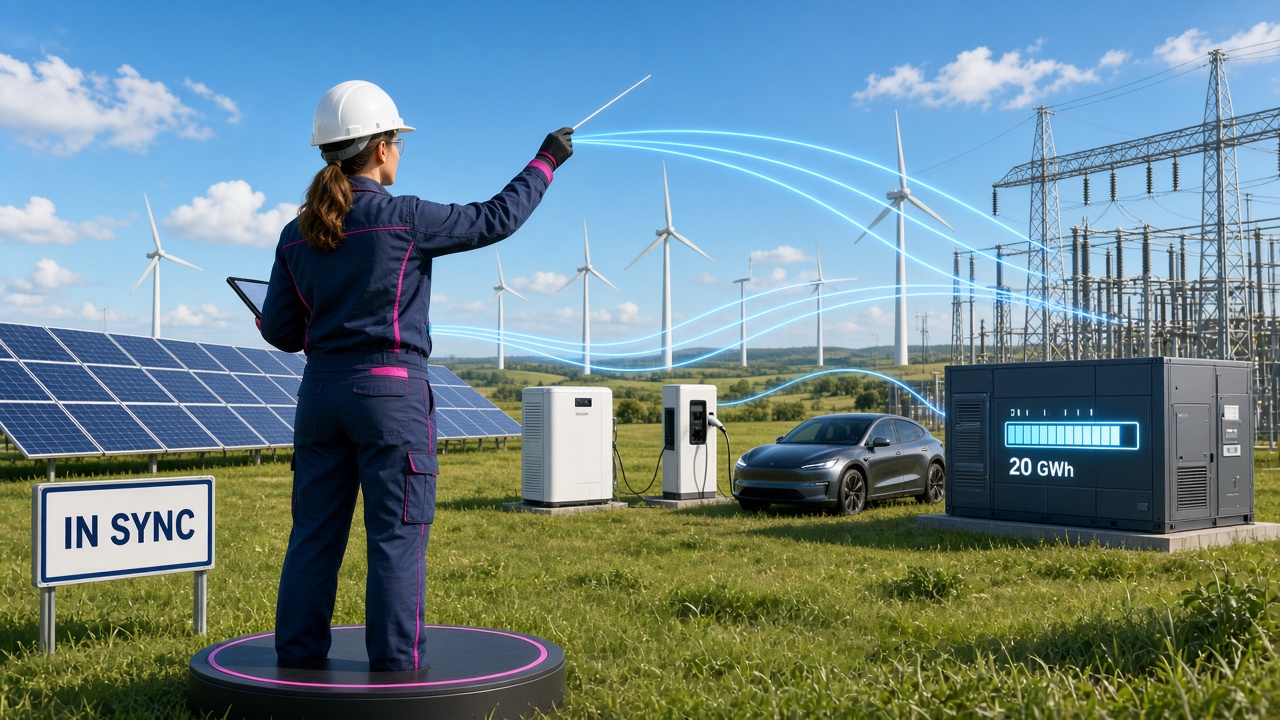
Grid batteries tripled to a record 20 GWh and home batteries passed 600,000. Why making solar, storage and EVs work together is the next big sparky skill.
At 4:15 pm on Friday 6 November, the grid batteries on Australia's main grid were holding more energy than ever before. Across the National Electricity Market, big batteries had soaked up 20.17 GWh of midday sunshine, ready to push it back out into the evening peak.
A year earlier, the record was 6.66 GWh. That's a 203% jump in twelve months.
I've been writing about batteries on this blog for weeks now, and I'll keep doing it, because the numbers keep getting bigger. But this week's data tells a slightly different story, and I think it's the most important one yet for anyone holding an electrical licence in Australia or New Zealand. We've got the hardware. The next challenge, and the next big opportunity, is making it all work together.
The numbers from the last fortnight
Here's what landed in the past couple of weeks, with sources so you can dig in yourself.
Grid-scale batteries tripled in a year. The 20.17 GWh record comes from analysis by Geoff Eldridge of Global Power Energy, using its GPE NEMLog platform, as reported by Energy-Storage.News and RenewEconomy. New South Wales set its own record of 8.36 GWh, up 188% on the 2.90 GWh it hit in October 2025. On the same day, NEM-wide utility solar availability peaked at 10,561 MW and Victoria's utility solar output hit a record 1,588 MW.
But a lot of clean energy still went unused. The same analysis estimated that 41.36 GWh of renewable generation was curtailed across the NEM that day: 26.67 GWh of solar and 14.69 GWh of wind. In NSW alone, 15.68 GWh was curtailed, almost all of it solar. Eldridge put it perfectly: "The question is increasingly not just how much generation and storage capability we have, but how effectively the NEM can utilise it."
Home batteries passed 600,000. Federal Energy Minister Chris Bowen announced that more than 600,000 residential and business batteries, close to 16.6 GWh of storage, have been installed under the Cheaper Home Batteries program since it started on 1 July 2025, pv magazine reported. More than 75% of them have gone into outer suburban and regional communities.
Systems are getting bigger again. SunWiz data shows Australians installed an estimated 1,043 MWh of small-scale battery capacity in October 2026, up 9.7% on September and the strongest month since April. The average system size rose to 26.74 kWh, its fifth straight monthly gain, and systems of 20 kWh and above made up 85% of capacity. NSW led with 356 MWh, Victoria rose 17% to 227 MWh, and Queensland was up 5% to 217 MWh.
The pipeline is still huge. AEMO connected a record 9.1 GW of renewables and storage to the NEM in FY26, and its connections pipeline has grown to 75.4 GW, with batteries making up 52% of that capacity (via Energy-Storage.News).
Put those together and you get a clear picture. Australia now has an enormous, fast-growing fleet of solar panels, inverters and batteries, on rooftops and in paddocks. The bottleneck is shifting from "can we build it?" to "can we make it all talk to each other, respond to the grid and actually use every kilowatt-hour?"
Why that's brilliant news for sparkies
Here's my take. The first wave of the energy transition rewarded people who could install. The next wave rewards people who can integrate.
Think about what a typical new job looks like in 2026. It's rarely just a few panels on a roof. It's a hybrid inverter, a 25 to 40 kWh battery, maybe an EV charger, maybe a heat pump, maybe a three-phase upgrade, all sitting behind a meter on a network that may limit exports or ask the system to respond to signals. Every brand behaves differently. Every network has its own connection rules. And when something doesn't work, the customer doesn't call the manufacturer. They call you.
That's exactly what Swinburne University of Technology found when it went out and asked the industry. On 6 November, Swinburne announced five new microcredentials to upskill licensed electricians in integrated power systems, where solar, batteries, EV chargers, loads and the grid interact. The training focuses on four gaps: understanding how integrated systems work, configuration and commissioning, testing and fault-finding, and keeping up with changing standards, site requirements and technologies.
Senior Educator in Electrical Trades Ash Reid summed it up: "Commissioning and fault-finding are where electricians told us they need more support, particularly as every system and brand behaves differently."
That's the honest truth from the coalface, and I love that the response is practical. Swinburne built the content around real-world scenarios rather than one product or brand, co-designed it with industry, and also developed learning modules for Certificate III in Electrotechnology apprentices plus solar and battery digital learning materials for installer accreditation. The project was delivered through the Victorian Skills Authority's VET Certificates in Renewable Energy program, with TAFE Gippsland, South West TAFE and Federation University, and the materials will be shared with TAFEs across Victoria.
Across the Tasman: New Zealand's solar build keeps rolling
New Zealand is a few years behind Australia on utility solar, but it's moving quickly, and the projects are getting serious.
- Kōwhai Park is open. Contact Energy and Lightsource bp officially opened the South Island's largest solar farm at Christchurch Airport on 15 October: 150 MWac (168 MWdc), around 300,000 panels across 230 hectares, and an expected 275 GWh a year. The $273 million project employed 235 people at peak construction and involved 66 Canterbury businesses. Contact says it has two more consented sites in Taranaki and Northland with Lightsource bp.
- Western Bays is on the fast track. Meridian Energy's proposed 420 MW Western Bays Solar Farm near Lake Taupō has been referred for consideration under the fast-track consenting process, BusinessDesk reported on 9 November. If approved, it would generate an estimated 870 GWh a year, about 2% of the country's current generation.
- Two farms at the foot of Ruapehu. The Karioi Solar Farm (development rights now held by Anza Power) and Harmony Energy's 156 MW Tangiwai Hybrid Solar Farm are being developed off the Volcanic Loop Highway between Waiōuru and Ohakune, both feeding into Transpower's Tangiwai substation, the Whanganui Chronicle reported. Karioi is targeting financial close early next year, with construction expected to start in late 2027.
For Kiwi sparkies, that's a pipeline of construction, commissioning and long-term maintenance work that simply didn't exist five years ago. And because New Zealand is building solar alongside a grid that's already heavily renewable, the integration lesson Australia is learning right now applies there too.
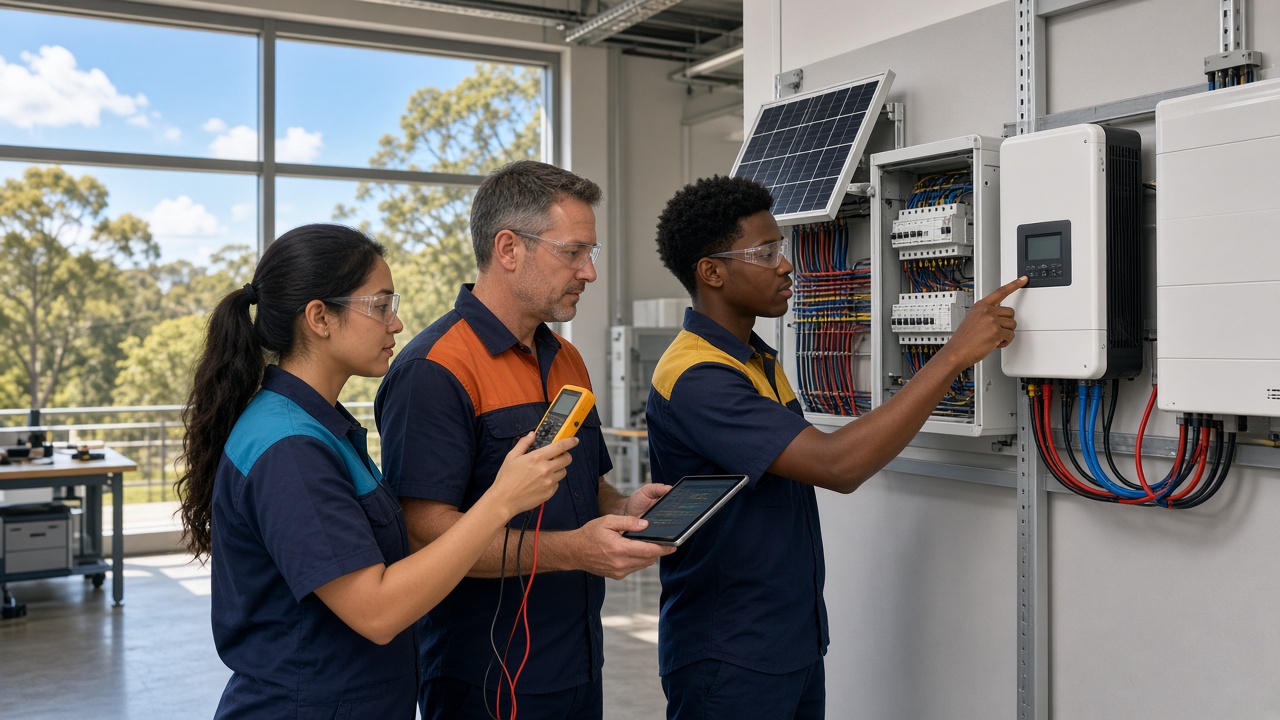
Solar, battery and EV charger on one rig: the integration skills that are now in demand.
What the integration era looks like on the tools
If I were a licensed electrician reading this, here's where I'd be putting my energy over the next 12 months.
1. Get properly good at commissioning. Commissioning is where an installation becomes a working system. It means configuring inverter settings to the network's requirements, setting up battery modes and backup circuits, checking communications, and proving it all works before you leave. A tidy install that's configured badly still ends up as a callback. Sparkies who commission well save their employers money and earn their customers' trust.
2. Treat fault-finding as a premium skill. With 600,000 rebated home batteries out there and the average size climbing, a big after-market is building: warranty work, firmware issues, comms dropouts, systems that never got set up right. If you can walk into a stranger's install, read the logs, test methodically and fix it, you'll never be short of work.
3. Learn more than one brand. Swinburne's whole point is that every system behaves differently. Pick the three or four platforms you see most in your area and learn them deeply. Manufacturer training is often free or cheap, and it's worth every hour.
4. Understand the grid side. The curtailment numbers are a reminder that location, transmission constraints and local conditions matter. You don't need to be a market analyst, but understanding why a network limits exports, what a flexible export setting does and how batteries can respond to signals makes you a far better adviser to customers.
5. Keep your accreditation and standards current. Standards move quickly in this space. If you're in Victoria, keep an eye on the new microcredentials as they roll out through TAFEs. Wherever you are, budget time each year to stay current. It's the cheapest insurance in the trade.
For employers: hire for the system, not just the install
If you run a solar, battery or electrical contracting business, I'd encourage you to think about how you hire and train. The businesses winning right now aren't just the ones with the most install crews. They're the ones with people who can commission cleanly, troubleshoot confidently and explain the system to the customer at handover.
A few ideas that cost very little:
- Pair your strongest commissioner with your newer sparkies and apprentices for a few weeks.
- Build a simple internal checklist for every brand you install, and update it every time you hit a curly problem.
- Back your team into short courses like the new microcredentials, and treat it as an investment rather than a cost.
- When you advertise, say what systems you work with and what training you offer. Good sparkies want to know they'll keep learning.
My take: the boring part is the exciting part
I know "integration" doesn't sound as thrilling as a new record-breaking battery park. But honestly, this is where the magic happens. Australia has gone from 6.66 GWh to 20.17 GWh of stored grid energy in a year, and from zero to 600,000 rebated home batteries in about 16 months. That's one of the fastest energy build-outs anywhere in the world, and it was done by real people on real job sites.
The next step is making all of it work smarter: soaking up more of that curtailed sunshine, shifting it to when it's needed, and keeping every system running reliably for years. That's skilled, interesting, well-paid work, and it won't be done by software alone. It needs sparkies who understand both the copper and the code.
If that sounds like you, or the career you want, have a look at the solar, battery and commissioning roles on ElectricalRoles.com.au and set up a job alert. The integration era is here, and it's going to be a good one.