
What Does a Level 2 Electrician Do? ASP Pay and Pathways
Level 2 electricians connect homes and businesses to the grid in NSW. What the job involves, the ASP classes, training, pay and how to get started.
Every home battery, every EV charger, every new granny flat and every new estate in New South Wales has one thing in common. At some point, somebody has to connect it to the street. That somebody is very often a Level 2 electrician, and it's one of the most underrated, best-paid niches in the Australian trade.
If you've done your apprenticeship, you've got your licence and you're wondering what's next, Level 2 is well worth a look. It gets you out of the ceiling space and onto the network side of the meter, it's in steady demand, and it turns you into the person homeowners and builders call when nobody else can legally do the job.
In this edition of our "What does a ___ do?" series, I'll walk through what Level 2 work actually involves, how the accreditation works, what it costs to train, what it pays and how to get your foot in the door.
What is a Level 2 electrician?
"Level 2" comes from the NSW Accredited Service Provider (ASP) Scheme. The scheme accredits companies to carry out "contestable" work on the state's three electricity distribution networks (Ausgrid, Endeavour Energy and Essential Energy), so customers can use a private contractor instead of waiting for the distributor.
The scheme has three levels, as set out on the NSW Government's ASP page:
- Level 1: construction of network assets (overhead and underground distribution lines, the poles-and-wires work).
- Level 2: connection services, meaning building or changing the service line between the distribution system and the customer's point of connection, plus work on network devices such as the service protection device on the main switchboard.
- Level 3: design of overhead and underground distribution assets.
So a Level 2 electrician owns the last few metres: from the pole or pillar in the street to the customer's switchboard. Ordinary licensed electricians can wire everything inside the property, but they can't touch the service connection itself. That's the gap Level 2 fills.
What does a Level 2 electrician actually do day to day?
The work is varied, and that's part of the appeal. A typical week might include:
- Disconnecting and reconnecting power so another electrician can safely upgrade a switchboard.
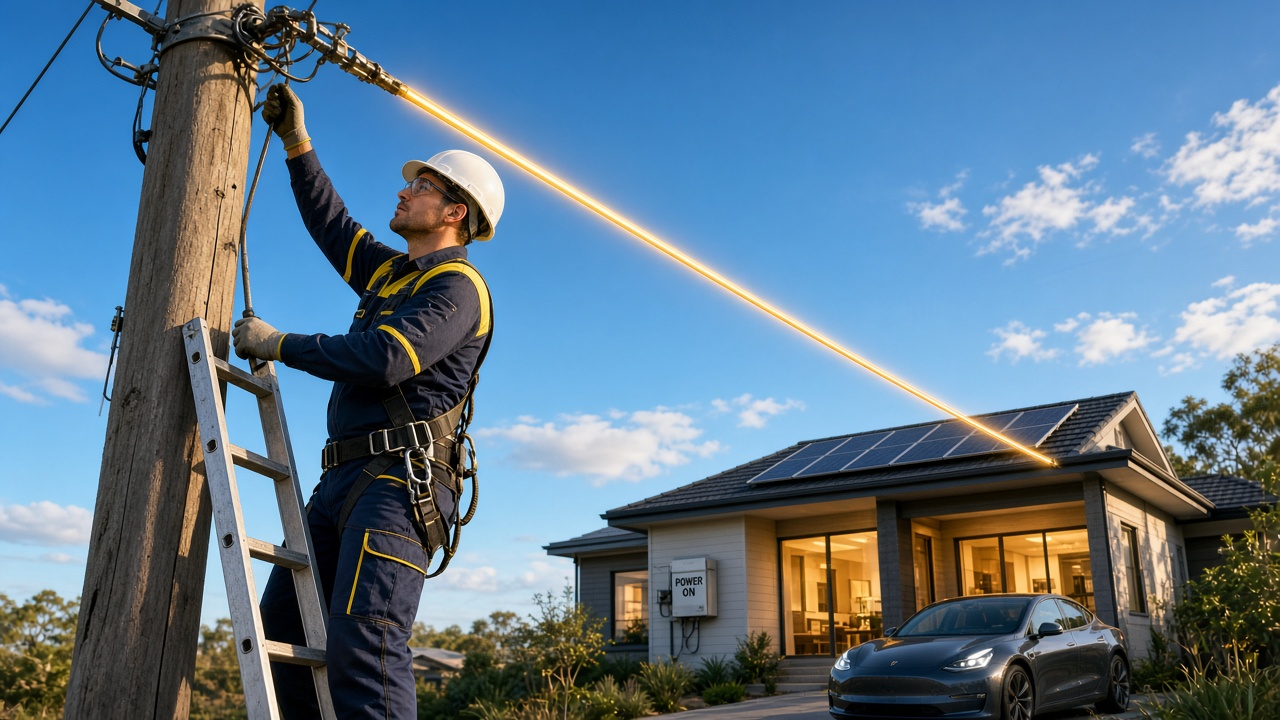
- Installing new overhead services, running a new aerial cable from the street pole to a house, often from an elevating work platform or ladder.
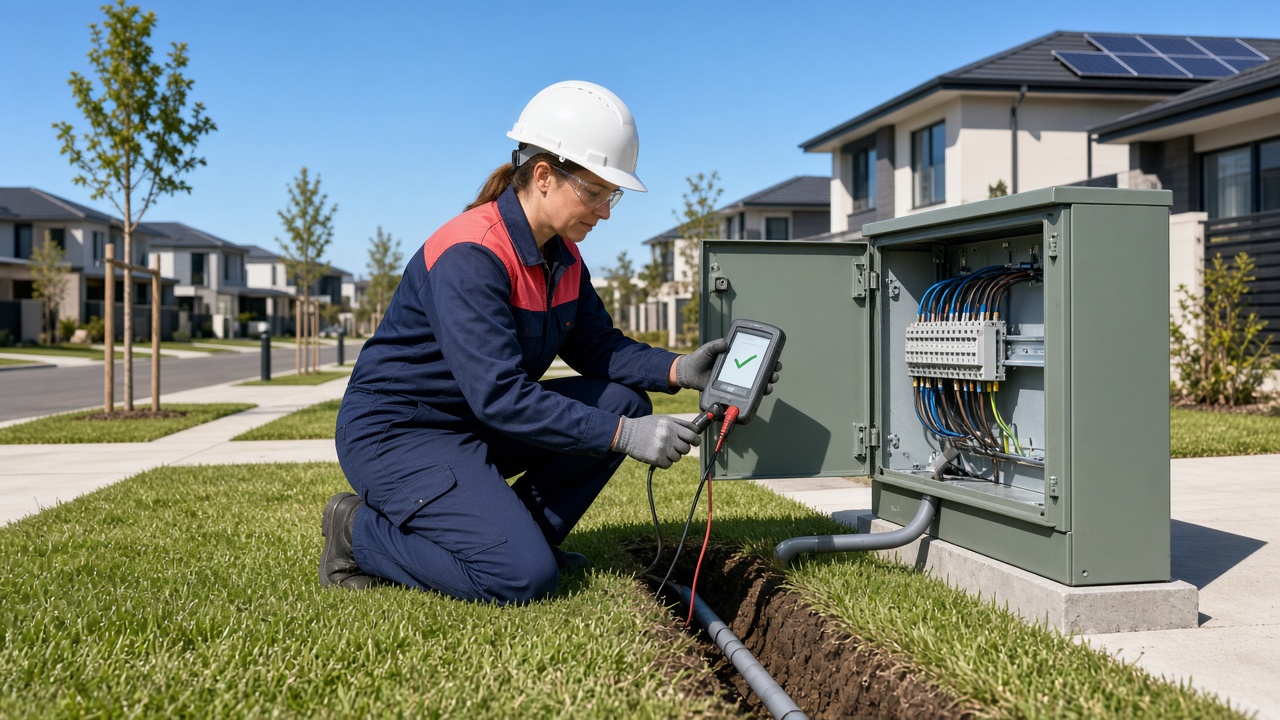
- Installing underground services, connecting a new home in a housing estate from the street pillar to the meter box.
- Upgrading single-phase supplies to three-phase so homeowners can add big solar systems, batteries or fast EV chargers.
- Consumer mains upgrades, replacing old, undersized cabling between the point of attachment and the switchboard.
- Private power poles on rural and semi-rural blocks, which is a big slice of the work outside the cities.
- Energising new installations and doing the connection testing that proves everything is safe before the power goes on.
It's practical, outdoor, problem-solving work. You're often the final step before a family can move into a new home or switch on a new battery, so it comes with a pretty good feeling at the end of the job.
The four Level 2 classes
Level 2 is split into classes, and both the business and the worker can hold one or several. Based on the current NSW qualification table, as summarised by Venux Electrical's guide:
- Class 2A: Disconnect and reconnect at the connection point.
- Class 2B: Underground services, installing and maintaining low-voltage underground services.
- Class 2C: Overhead services, installing and maintaining low-voltage overhead services.
- Class 2D: Energising service equipment, including disconnection and reconnection within that scope.
One thing that trips people up: metering is no longer part of the NSW ASP scheme. You'll still see old course lists and older electricians talking about "2D metering", but check the current table before you enrol.
How do you become a Level 2 electrician?
This is the bit most people find confusing, because it isn't a single course. There are three separate steps, and they all have to line up.
1. Get the right qualifications. You start with an accepted core electrical qualification or NSW electrical licence, then add the mandatory competency units for each class you want. For example, the current combinations include UETDRIS011 for underground services (2B), UETDRIS010 for overhead services (2C) and UETDRMP011 across the classes, with extra units for 2A and 2D. Course codes do change, so always check the current NSW table and confirm with your training provider.
2. Work through an accredited business. The ASP scheme accredits the company, not the individual. Once a business is accredited, each employee or subcontractor is registered against that accreditation through the NSW ASP Platform. Accreditation is granted for up to a year at a time, and the NSW Government now cancels accreditations that aren't renewed by their expiry date, so stay on top of it if you run your own show.
3. Get authorised by the distributor. Registration still doesn't let you work on the network. The business and its workers must be separately authorised by the network operator in the area: Ausgrid (Sydney, the Central Coast, Newcastle and the Hunter), Endeavour Energy (Greater Western Sydney, Wollongong and the Illawarra) or Essential Energy (the rest of NSW). Each has its own safety rules training, and many roles need annual refreshers.
For most people the easiest route is to join a business that already holds ASP accreditation and is willing to train you up. Plenty of employers advertise exactly that. A Level 2 role on the NSW Far North Coast currently listed on SEEK, for example, offers "training and support to get your ASP classes, authorisations and tickets".
What does the training cost?
Less than you might think, for the earning power it unlocks. NECA Training in Canberra, for example, lists its courses as:
- Class 2B Underground: $1,395 (GST exempt), three days.
- Class 2C Overhead: $1,795 (GST exempt), four days.
You'll need to complete statutory and core training first, then the distributor's safety rules training on top. Prices vary between providers, so shop around, and ask your employer whether they'll cover it. Many will.
What does a Level 2 electrician earn?
Level 2 pays a premium over general electrical work because fewer people can do it and the work can't wait. A sample of current advertised roles:
- A Level 2 ASP electrician role for underground and overhead services around West Ballina, Lismore and the Far North Coast, advertised on SEEK at $45 to $55 an hour plus overtime and allowances, with training to get your classes.
- An electricity meter technician role across the Endeavour Energy network in Parramatta, doing switchboard isolations for meter exchanges, advertised at a minimum of $120,000 plus super and a vehicle.
Advertised rates vary a lot by region and employer, so treat those as a snapshot, not a ceiling. The pattern I see: base rates similar to or a bit above a good licensed electrician, then overtime, on-call and allowances on top. The real upside comes when you own the accreditation yourself. Being the local Level 2 business in a growing regional town is a seriously good business.
Why demand is only heading one way
I'm genuinely bullish on Level 2 for the next decade, for one simple reason: electrification runs through the service connection.
Australia's home battery boom, three-phase upgrades for EV chargers, heat pumps replacing gas, new housing estates on the edges of Sydney, the Hunter and the Central Coast, granny flats, and ageing overhead services that need replacing. Every one of those ends up needing someone to disconnect, upgrade, reconnect or energise. Homeowners don't want to wait weeks for the network, so the contestable market keeps growing.
There's also a natural career ladder. Level 2 work exposes you to the network side of the industry: distributor safety rules, LV networks, underground and overhead construction. From there it's a smaller step into Level 1 network construction, cable jointing, lineworking, field supervision or even training. One SEEK ad right now is for a Powerlines and ASP trainer assessor on the Central Coast at $95,000 to $112,500 including super, plus a car and bonus.
What about other states and New Zealand?
Level 2 is a NSW term, tied to the NSW ASP scheme. Other states and territories handle service connections differently, and in many places that work sits with the distributor or its approved contractors. If you're outside NSW, ask your local network operator how service work is arranged and what authorisations they require.
In New Zealand, connecting to the network is also controlled by each local lines company, which sets its own rules for approved contractors. The underlying skills transfer well: if you can safely run and terminate an LV service and test it properly, you're valuable on both sides of the Tasman.
Is Level 2 right for you?
It suits you if you:
- like being outdoors and on the move rather than on one site for months;
- are comfortable at heights and around live LV networks, with a strong safety mindset;
- enjoy being the person who solves the problem on the spot;
- want a clear path to running your own business.
My advice: if you're a licensed sparky in NSW and you want to earn more without leaving the state, talk to a few accredited Level 2 businesses about joining them and getting your classes. It's one of the quickest, most affordable upskills in the trade, and the work isn't going anywhere.
You'll find Level 2, network and distribution roles on ElectricalRoles.com.au. Set up a job alert and be first in line when the next one comes up.