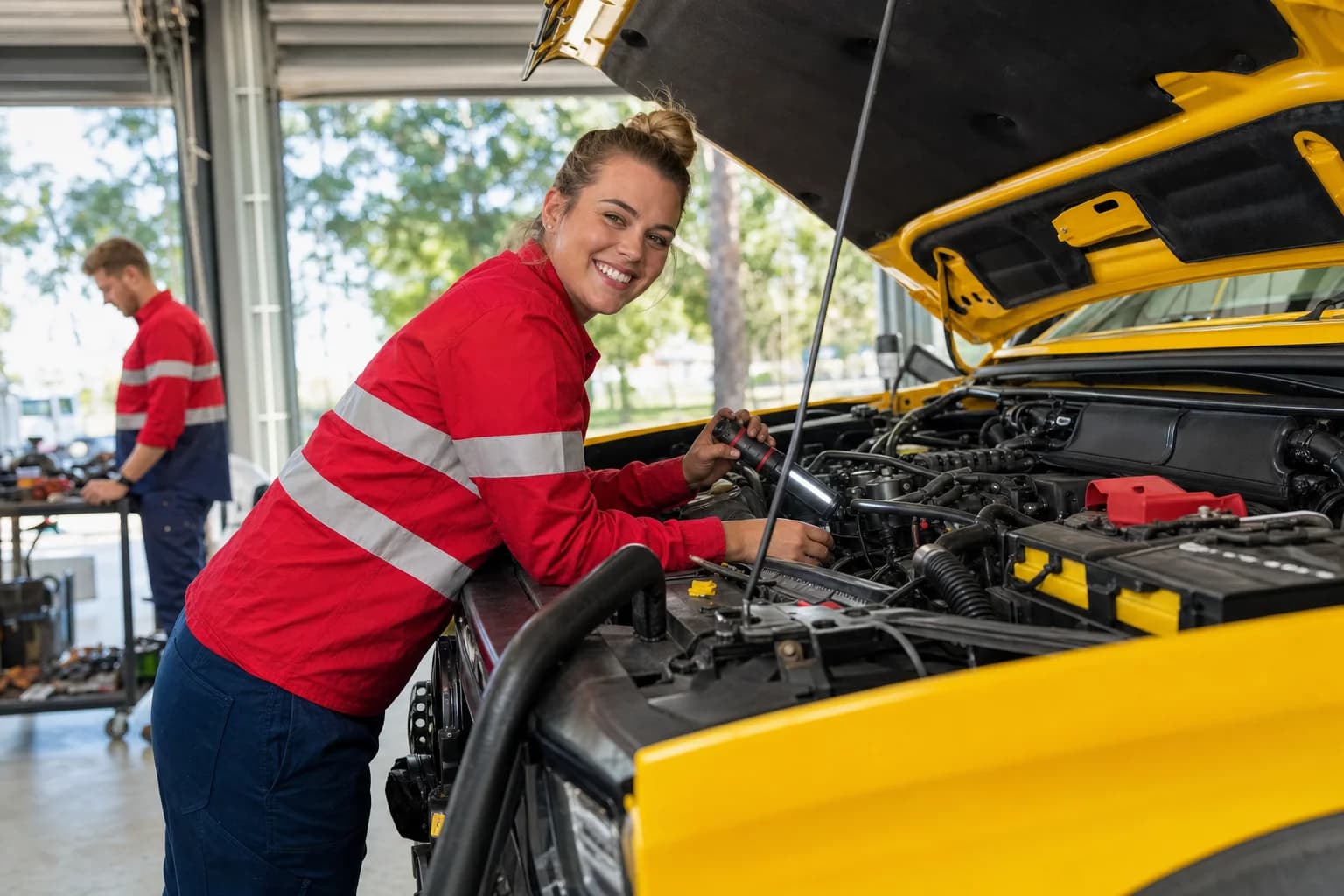
What does an auto electrician actually do?
Auto electricians install, fault-find and repair the wiring and electronics in vehicles. Jobs and Skills Australia lists the core tasks: finding faults with test gear, testing and replacing alternators, regulators and starter motors, adjusting engine control systems, and repairing ignition and wiring faults. In Western Australia the official job profile also covers marine craft and mining equipment, as well as passenger and commercial vehicles.
The work has moved well past lights and starters. In July 2026 the national qualification added electives on diagnosing and calibrating advanced driver assistance systems (ADAS). It already offered units on depowering hybrid vehicles, replacing heavy EV battery packs and working safely with hydrogen. Expect to spend a lot of your day with a scan tool and a meter, and less of it with spanners.
How is it different from an electrician's licence?
They are separate trades with separate qualifications. The training package for AUR30320 states that no licensing, legislative or certification requirement attaches to it. So finishing your auto electrical apprenticeship does not make you a licensed electrician.
Electrical licences cover installation work above extra-low voltage. In Western Australia, for example, you need a licence from the Electrical Licensing Board for work on anything over 50 volts AC or 120 volts DC. Most vehicle systems run on 12 or 24 volt DC, which sits outside that rule. If a job means wiring 230 volt mains circuits, for example in a caravan or a workshop, it needs a licensed electrician.
Where is the work: fleets, mining, heavy vehicles and EVs
Queensland has the biggest share of auto electricians, about 32.7 per cent of the national workforce. New South Wales has 16.8 per cent and Victoria 15.4 per cent. Most work happens in workshops: independent auto electrical shops, dealerships and service centres. Some auto electricians run mobile vans and go to customers' homes or worksites.
Mining is a big employer, especially in Western Australia, where mine site roles are often fly-in fly-out. Victoria's course listing names trucks, caravans and trailers as well as cars, so heavy vehicle and transport fleet work is part of the trade. Electives in hybrid, heavy EV battery and hydrogen systems are a good start if you want to work on newer fleets.
What do auto electricians earn?
Jobs and Skills Australia reports median full-time earnings for auto electricians of $2,808 a week, from the ABS May 2025 earnings survey. Census data (2021) shows full-time auto electricians average 49 hours a week, compared with 44 hours across all occupations, so overtime is likely part of that earnings figure. Mining and remote roles usually pay more than suburban workshops.
Apprentices earn a percentage of the adult rate, and that percentage rises each year. Automotive workshops generally fall under the Vehicle Repair, Services and Retail Award 2020 (MA000089), not the electrical contracting award. Ask any employer which award or agreement covers the job before you sign.
Pay
AUD a year, before tax. These are general electrician figures based on ABS Employee Earnings and Hours, May 2025, moved to 2026 with a wage index. State figures are modelled, not official. Overtime, mining and remote work, and the award or agreement you work under all move the figure. Refer to the Industrial & Mining Electricians salary guide for figures from live adverts.
What you need
- ApprenticeshipYou need a training contract with an employer. It combines paid work with structured training at a registered training provider. School-based apprenticeships are also available.
- AUR30320 Certificate IIIThe packaging rules require 32 units: 21 core units and 11 electives. The core covers wiring, charging, starting, ignition, engine management and body electronics.
- Entry requirementsEntry requirements depend on the training provider, and you need an employer to take you on as an apprentice. TAFE NSW recommends Year 10 level literacy and numeracy and an interest in automotive electronics.
- ARC refrigerant handling licenceYou need this licence to work on vehicle air conditioning. TAFE NSW says you become eligible by completing the electives AURETU002, AURETU003 and AURETU004.
- WA motor vehicle repairer certificateIn Western Australia you need a Motor Vehicle Repairer's Certificate, or you must work under someone who holds one. Applicants need a National Police Certificate.
State by state
| Western Australia | You need a Motor Vehicle Repairer's Certificate, or you must work under the supervision of a holder, plus a National Police Certificate. Any electrical work above 50 volts AC or 120 volts DC needs a licence from the Electrical Licensing Board. |
|---|
How to get there
- Before startingFind an employerApproach auto electrical workshops, dealerships, fleet operators or mining contractors for an apprenticeship. You can also start as a school-based apprentice.
- Year 1-2Core trainingLearn safe work practice, test equipment, soldering, wiring harness repair, lighting, batteries, charging and starting systems.
- Year 2-4Diagnostics and electivesMove on to engine management, body electronics and diagnostic strategy. Pick electives such as air conditioning, ADAS, hybrid depowering or heavy EV battery systems.
- Year 4Qualify as a tradespersonFinish the AUR30320 Certificate III. Most apprenticeships take 42 to 48 months in total.
- Year 4 onwardAdd licences and specialiseGet your ARC refrigerant handling licence if you completed the air conditioning units. Then move into mining, heavy vehicles, mobile work or EV and ADAS diagnostics.
Open now on ElectricalRoles.com.au


Questions people ask
Is an auto electrician a licensed electrician?
No. The AUR30320 Certificate III carries no licensing requirement, and it doesn't qualify you to do mains electrical installation work. For that you need a separate electrical apprenticeship and a state electrical licence.
How long does it take to become an auto electrician?
An auto electrical apprenticeship usually takes 42 to 48 months. You work for an employer the whole time and complete structured training with a registered training provider.
Can auto electricians work on electric vehicles?
Yes. The Certificate III has electives for depowering and reinitialising hybrid vehicles, replacing heavy EV rechargeable energy storage systems, and working safely with hydrogen. Since July 2026 it also has electives on diagnosing and calibrating ADAS.
Do I need a licence to regas car air conditioning?
Yes. You need an ARC refrigerant handling licence. TAFE NSW lists three air conditioning electives in the Certificate III that make you eligible to apply.
Can I become an auto electrician as an adult?
Yes. Apprenticeships are open to school leavers, people returning to work and mature-aged career changers. Your employer signs a training contract with you the same way they would for a younger apprentice.
Sources
- training.gov.au: AUR30320 Certificate III in Automotive Electrical Technology
- training.gov.au: AUR30320 Release 3 qualification document
- Jobs and Skills Australia: Automotive Electricians (ANZSCO 3211)
- Jobs and Skills WA: Automotive electrician
- WA Government: Electrical licensing
- TAFE NSW: Certificate III in Automotive Electrical Technology
- Skills Victoria: Certificate III in Automotive Electrical Technology
- Fair Work Ombudsman: Vehicle Repair, Services and Retail Award 2020