
What licence does EV charger work need?
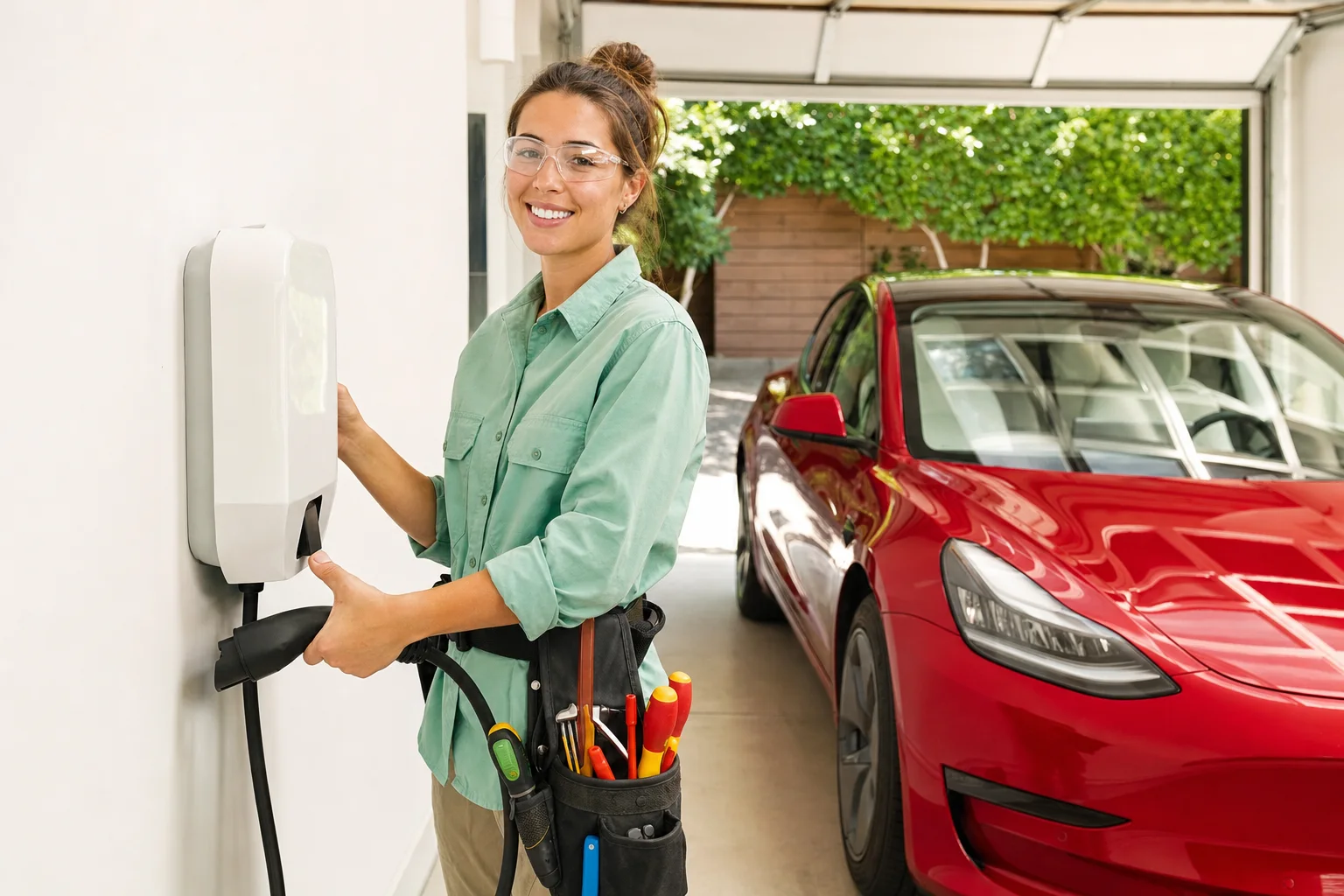
A dedicated home charger is wired straight into the home's power supply. The federal energy.gov.au guidance says a licensed electrician has to install it, and it notes the job can mean upgrading the switchboard and the supply connection. There is no separate national EV installer licence. Your ordinary electrical licence is the ticket.
Every state applies its usual compliance rules. In NSW, all electrical wiring work has to be done by a licensed electrician or under one's supervision. The tester then lodges a Certificate of Compliance for Electrical Work (CCEW) with Building Commission NSW. Each missed CCEW can attract an on-the-spot fine of up to $1,000. Failing to meet the technical standards carries penalties of up to $550,000.
What training is on offer once you are licensed?
In Victoria, Solar Victoria funds limited free places in the accredited 22609VIC Course in Electric Vehicle Charging Infrastructure up to 22kW. It is taught at TAFE Gippsland in Morwell and Holmesglen in Moorabbin. You do some self-paced online study, then one full day on campus. The course covers design, installation, testing and commissioning to Australian Standards, plus site assessment, supply capacity and fault finding.
NECA Education & Careers runs two shorter non-accredited courses: EV charging essentials, and EV charging in strata buildings. They cover AS/NZS 3000, AS/NZS 3008, maximum demand, load management and NCC 2022. TAFE NSW sells a one-hour online course, An Electrician's Guide to EV Charging. It gives no formal qualification and is meant for licensed electricians.
What do the jobs look like, from homes to fleets?
Most of the work is residential. Around 80 per cent of reported EV charging in Australia happens at home. A typical job is a 7 kW wallbox, which ACT guidance puts at about $2,000 to $3,000 installed. Some jobs need an upgrade to three-phase power.
Strata car parks are harder work. You need body corporate approval and have to deal with maximum demand, load management and on-selling electricity. Government money is also going into commercial sites, including NSW programs for fleets, kerbside chargers, destination chargers and EV-ready buildings. The Victorian Government expects jobs in EV charging infrastructure in Victoria to grow fourfold, to 14,300 workers.
Pay
AUD a year, before tax. Typical figures are modelled from ABS Employee Earnings and Hours, May 2025, moved to 2026 with a wage index, and state figures are modelled too. The award minimum comes from the Electrical, Electronic and Communications Contracting Award 2020, effective 1 July 2026. Overtime, location and commercial or fleet work push pay up. Refer to the Renewables & Solar salary guide for figures from live adverts.
What you need
- Electrical licenceHardwired EV chargers must be installed by a licensed electrician. Apprentices work under supervision.
- Compliance certificateIn NSW the tester lodges a CCEW with Building Commission NSW for the work. Penalties apply for each missed certificate.
- Standards knowledgeWork to AS/NZS 3000. Queensland fire guidance points to its Appendix P on where to locate EV charging equipment and how to install it.
- Compliant equipmentNSW guidance tells customers to use only chargers that carry the Regulatory Compliance Mark.
- Strata approvalUnits and apartments need body corporate or strata approval before a wallbox goes in.
- EV-specific trainingNot a legal requirement, but courses such as 22609VIC build design and commissioning skills up to 22kW.
State by state
| New South Wales | Wiring work must be done by or under a licensed electrician, with a CCEW lodged with Building Commission NSW. |
|---|---|
| Victoria | Solar Victoria's Electrification Skills Program fully funds limited places in the NECA EV courses, and up to 110 places in 22609VIC until the end of June 2027 or until funding runs out. They are open to licensed electricians and fourth-year apprentices. |
| Australian Capital Territory | EV charger installation needs an ACT licensed electrician. Zero-interest Sustainable Household Scheme loans can cover a charger and a three-phase upgrade in existing homes, but new builds are not eligible. |
How to get there
- Years 1-4Electrical apprenticeshipTrain as an electrician. The contracting award sets apprentice wages for four years, rising from $559.55 a week in year 1 to $917.66 in year 4.
- Year 4EV short course as an apprenticeIn Victoria, fourth-year apprentices with low voltage install and test experience can take the funded EV courses.
- After tradeGet your electrical licenceGet licensed in your state or territory. Without it you cannot sign off hardwired charger installs.
- Licensed year 1Accredited EV trainingTake 22609VIC or a similar course to design, install and commission chargers up to 22kW.
- Licensed years 1-2Domestic wallboxesBuild experience on 7 kW home installs, switchboard upgrades and three-phase jobs.
- Licensed year 2+Strata, commercial and fleetMove into car parks, load management and grant-funded fleet and public charging sites.
Questions people ask
Can I install EV chargers without being an electrician?
No. A dedicated EV charger is connected directly to the power supply, so a licensed electrician has to install it. TAFE NSW also says you need to be a qualified, licensed electrician to install EV chargers.
Is there a separate EV charger licence in Australia?
None of the sources reviewed for this guide mentions a separate national EV installer licence. Your standard electrical licence covers the work, and EV courses add specialist skills on top of it.
Can apprentices do EV charger training?
Yes, in some programs. Victoria's funded 22609VIC and NECA courses take fourth-year apprentices who have experience installing, testing and commissioning low voltage installations.
How long is the Victorian EV charging course?
22609VIC is blended learning. You do some self-paced online study first, then one full day on campus at TAFE Gippsland or Holmesglen.
Are there rebates that bring in EV charger work?
Yes, in some places. The ACT Sustainable Household Scheme offers zero-interest loans that can include a three-phase upgrade. NSW runs grant programs for fleet, kerbside and destination charging.
Sources
- Solar Victoria: EV charger design and installation training
- energy.gov.au: How to charge your electric vehicle
- NSW Fair Trading: Electrical compliance requirements
- NSW Climate and Energy Action: Install a home EV charger
- ACT Government Climate Choices: guide to EV chargers
- TAFE NSW: An Electrician's Guide to EV Charging
- Queensland Fire Department: Electric vehicle fire safety