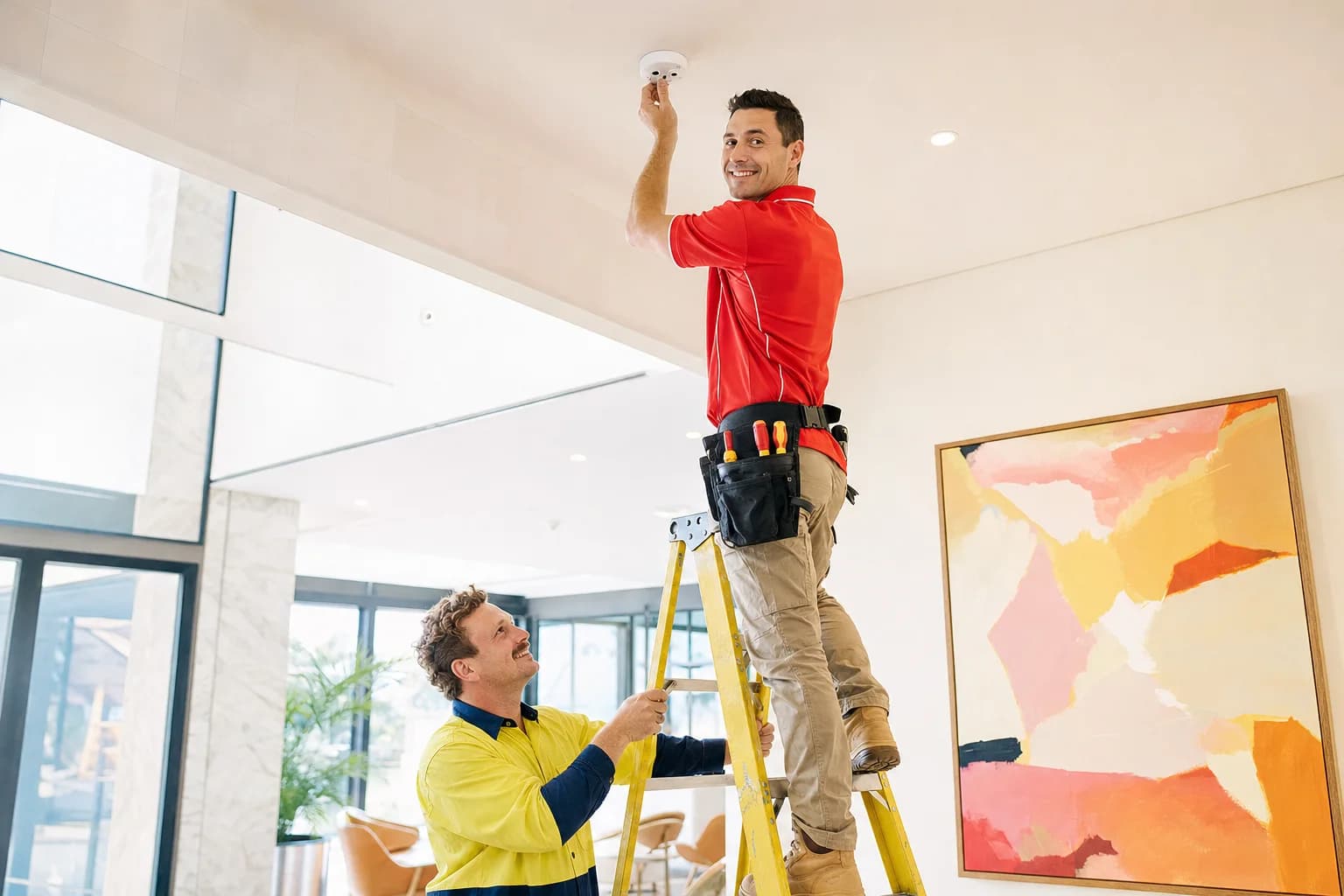
What does a fire alarm technician do?
A fire alarm technician installs, programs, tests and repairs fire detection and warning systems in commercial and residential buildings. That covers detectors, control and indicating panels, sounders, and the warning and intercom systems tied into them. Much of the work is routine servicing: walking a site with a test kit, setting off detectors, checking the panel responds, and logging faults. The other half is new installs and fault-finding, which pays better and takes more skill. Most of the work runs at extra-low voltage. Mains connections to panels count as electrical work, and that needs an electrician.
Which qualification do you need?
The trade qualification for the job is the Certificate III in Fire Protection Control, UEE31020. QBCC accepts it for its fire alarm licence. UEE21020, the Certificate II in Fire Alarms Servicing, is the current entry-level course for base-level servicing work. On the inspection and testing side, the property services package has CPP20521, the Certificate II in Fire Protection Inspection and Testing, and CPP30821, the Certificate III in the same field. CPP30821 is aimed at technicians who do non-trade installation, commissioning and complex servicing, or who supervise fire services work.
What is the route for electricians?
Electricians have the shortest path. A licensed electrician can already do the mains side of a fire panel and knows cabling, terminations and testing. In Queensland, an electrical mechanic can apply for the QBCC occupational fire alarm systems licence and use the electrical licence to meet the technical qualification. If you want the contractor or nominee supervisor licence, you need 15 mandatory units of competency on top of your electrical licence. They include programming fire systems, installing detection apparatus and verifying installations. If you are an employee of a licensed contractor and hold an electrical mechanic licence, you do not need the occupational licence at all.
Do NSW and Victoria license this work?
NSW does not require accreditation to install fire safety measures or to do routine maintenance, testing and servicing on them. Accreditation applies to higher-level work: endorsing system designs and assessing measures for annual fire safety statements. The approved scheme is the Fire Protection Accreditation Scheme, run by Fire Protection Association Australia, and it includes fire detection and alarm systems. In Victoria, the Victorian Building Authority's fire protection plumbing class covers water-based systems such as hydrants, hose reels and sprinklers. It is a sprinkler fitter's licence, not a fire alarm technician's.
Pay
AUD a year, before tax. These are modelled figures for fire and security electronics trades. They start from ABS Employee Earnings and Hours, May 2025, and are moved to 2026 with a wage index, so state figures are estimates and not official rates. Your pay moves with overtime, after-hours callouts, an electrical licence, and whether you install or only service. Refer to the Fire, Security & Electronic Systems salary guide for figures from live adverts.
What you need
- Trade qualificationThe Certificate III in Fire Protection Control (UEE31020) is the main qualification for installing and maintaining fire alarm systems.
- Entry-level courseUEE21020 Certificate II in Fire Alarms Servicing covers base-level servicing. CPP20521 is the Certificate II in Fire Protection Inspection and Testing.
- Queensland licenceQBCC's Fire protection, electrical stream, install and maintain, fire alarm systems class covers extra-low voltage systems. It also covers fire collars fitted as part of that work.
- Experience for a contractor licenceQBCC wants two years' experience for this class, and apprenticeship or training time can count. Contractor and nominee supervisor applicants must also meet managerial and fit and proper requirements.
- Electrical licence for mains workIn Queensland, electrical work on fire equipment falls under the Electrical Safety Act 2002, not QBCC licensing. That means a licensed electrician must do any 240 V connection.
- NSW accreditation for certifyingYou need accreditation under an approved scheme such as FPAS to endorse fire safety system designs, performance solution reports or minor-works BCA exemptions, or to assess measures for annual fire safety statements. From 13 February 2027 (or earlier, once a scheme is approved), installed fire safety measures must also be certified by an accredited person before a Fire Safety Certificate is issued.
State by state
| Queensland | QBCC requires a fire protection licence to install and maintain extra-low voltage fire alarm systems. Non-electricians need UEE31020 or an equivalent course. Electrical mechanics can use their electrical licence for the occupational class. |
|---|---|
| New South Wales | Installing, routinely maintaining and testing fire safety measures needs no accreditation. Endorsing designs and assessing measures for annual fire safety statements needs accreditation under an approved scheme such as FPAS. |
| Victoria | The Victorian Building Authority licenses fire protection plumbing, which covers water-based systems such as sprinklers and hydrants. Fire alarm work does not fall under that class. |
How to get there
- Month 0-6Get a start with a fire services companyBegin as a trainee or offsider on servicing runs, testing detectors and panels under supervision.
- Year 1Complete an entry certificateDo UEE21020 Certificate II in Fire Alarms Servicing or CPP20521 if you are mostly doing inspection and testing.
- Year 1-3Finish the Certificate III in Fire Protection ControlUEE31020 is the trade-level qualification for installing and maintaining fire alarm systems.
- Year 2-3Get licensed where it is requiredIn Queensland, apply to QBCC for the fire alarm systems occupational licence. Electricians can apply on their electrical mechanic licence.
- Year 3+Move into contracting or certificationA QBCC contractor licence needs two years' experience. In NSW, FPAS accreditation lets you assess and endorse fire safety measures.
Questions people ask
Do you need to be an electrician to work on fire alarms?
No. Most fire alarm work runs at extra-low voltage, and non-electricians can qualify through UEE31020. You do need an electrician for mains connections to panels.
What licence do you need in Queensland?
QBCC issues a Fire protection, electrical stream, install and maintain, fire alarm systems licence for extra-low voltage work. If you are an electrical mechanic employed by a licensed contractor, you are exempt from the occupational licence.
Is a licence needed in NSW to service fire alarms?
No. NSW does not require accreditation to install fire safety measures or to routinely maintain, test and service them. Accreditation applies when you assess measures for annual fire safety statements or endorse designs.
How long does the QBCC contractor licence take to qualify for?
QBCC wants two years' experience for the fire alarm systems class, and time spent in an apprenticeship or training can count. You also need the technical qualification, and contractors must meet financial requirements.
Do battery smoke alarms in houses count as fire protection work in Queensland?
No. From 1 May 2021, QBCC's definition of fire protection work stopped covering installation and maintenance of battery-operated smoke alarms in class 1a and class 2 buildings.
What does a fire alarm technician earn?
The modelled national figure for fire and security electronics trades is about $101,100 a year. It ranges from about $89,300 in Tasmania to $110,600 in Western Australia. Callouts and overtime add to it.
Sources
- NSW Government: Fire safety practitioner requirements and accreditation
- QBCC: Licensing requirements for electrical mechanics installing or maintaining fire alarms
- QBCC: Fire protection, electrical, install and maintain, fire alarm systems
- QBCC: Changes to fire detection, alarm and warning system licences
- QBCC: Fire protection upskilling requirements
- training.gov.au: UEE21020 Certificate II in Fire Alarms Servicing
- Skills SA: CPP30821 Certificate III in Fire Protection Inspection and Testing
- Victorian Building Authority: Fire protection work