
Grid Build Update: HumeLink Halfway, Marinus Gears Up, NZ 3.1 GW
HumeLink hits halfway on towers, Marinus Link gears up at Hazelwood North, WA's Northern Terminal is 85% done and NZ has 3.1 GW underway.
I spend a lot of time reading construction updates. I know, glamorous. But every month they tell me something the headlines often miss: the big transmission projects that'll carry Australia and New Zealand's clean energy aren't just plans and arguments any more. They're steel in the ground, cable on towers and equipment being tested. And every one of those milestones is work for electricians, lineworkers, cable jointers and HV specialists.
November's updates are some of the most encouraging I've seen. Here's my round-up, and what I think it means for your career.
HumeLink West: halfway there, and now with helicopters
Transgrid's HumeLink West November construction update is a great read. The 140 km western section, from Wagga Wagga to Maragle, needs more than 360 new transmission towers, two new substations (Maragle and Gugaa) and an upgrade of Wagga Wagga Substation at Gregadoo.
This month the delivery team reaches the halfway point of tower construction, with more than 180 towers fully assembled and erected. They've also completed around 1,000 tower piles, built about 335 km of access tracks and more than 330 tower foundation pads.
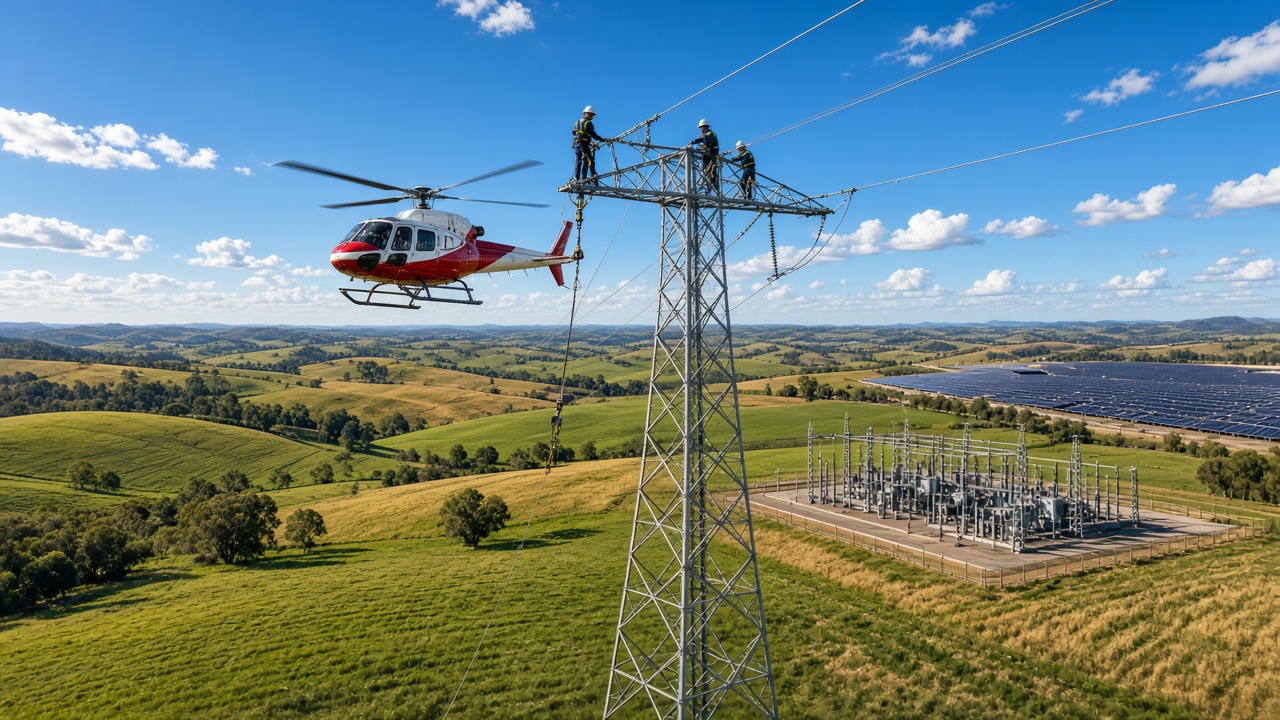
The bit I loved: helicopter stringing is starting on a section southeast of Wagga Wagga, between Tumbarumba Road and the Hume Highway. Drone stringing began in July. A drone or helicopter lifts a pilot cable onto temporary pulley blocks on each tower's cross arms, and that's used to pull the conductor from tower to tower. One Gilmore landowner, Pat Kelly, said of the work on his farm: "The helicopter was there for two or three days, then they were gone again... They were quick, quiet and very efficient."
That's the future of line work in one sentence. Drones and helicopters doing the dangerous lifting, skilled crews doing the precise work.
For electrical people, the most interesting line is about the substations. Transgrid says construction of the new 500 kV substations at Maragle and Gugaa has advanced significantly, with teams installing steel hardware and electrical equipment, and cables being installed on gantries and through conduits. That's substation electricians, HV testers and commissioning crews in demand right now.
HumeLink East: Bannaby testing ahead of December commissioning
The HumeLink East November update has its own milestones. More than 180 towers are completed between Bannaby and Wondalga, more than 270 km of access tracks are done, and more than 90% of tower pads are complete in the Tumut, Wyangle and Killimicat area. Transgrid says the project is on track to reach halfway on tower construction by the end of 2026.
The electrical highlight is at Bannaby, where high-voltage equipment is being tested ahead of commissioning in December. Helicopter stringing starts in that area from late November too.
If you've read my recent piece on what a commissioning electrician does, this is exactly that work in action: testing, proving and energising before handover.
Western Sydney: a new 330 kV bulk supply point approved
Also in NSW, Construction Review Online reports that Transgrid's Kemps Creek 330 kV Substation received its environmental determination in October. It will sit just south of the existing Kemps Creek 500 kV substation at West Hoxton, creating a new bulk supply point for Endeavour Energy's network to support the Western Sydney Priority Growth Area, including Western Sydney International Airport.
Construction is anticipated to start in June 2027, finishing in December 2028. That's a long lead time, but it's exactly the kind of pipeline that lets apprentices starting today plan for a career, not just a job. And it fits what I've been writing about Western Sydney's data centre growth for weeks.
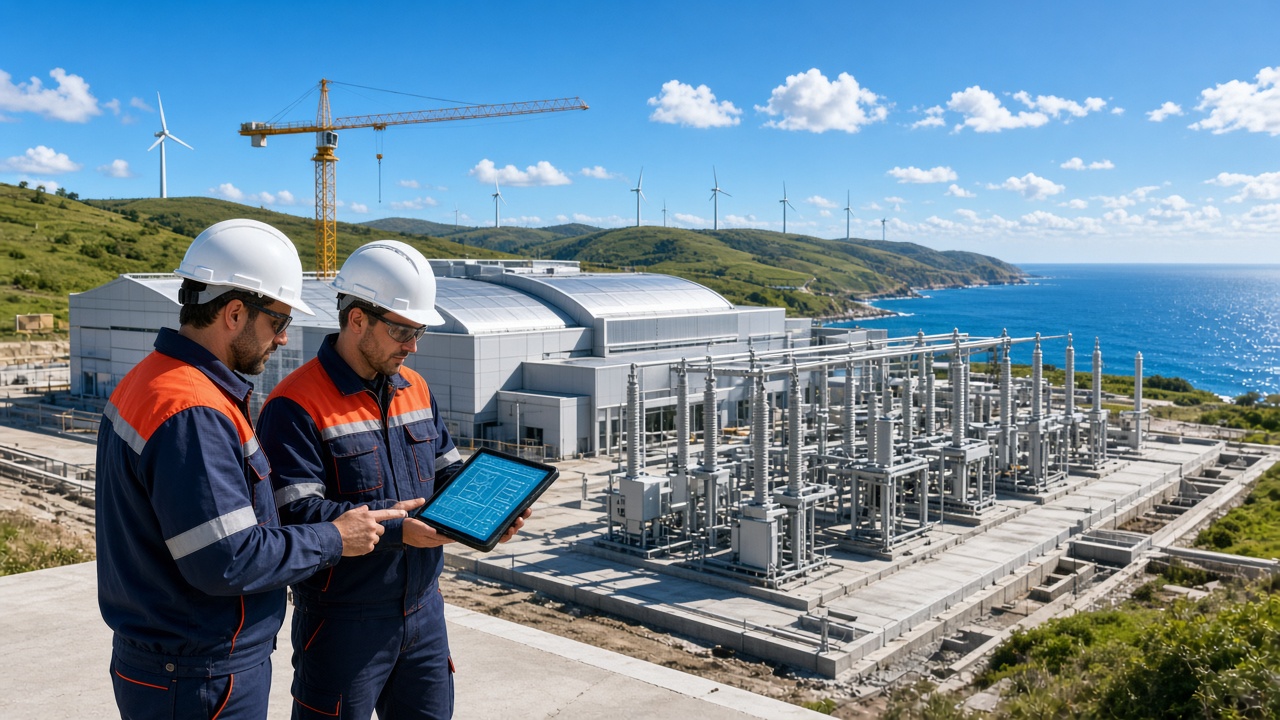
From civil works to electrical crews: converter stations and substations are where HV skills come to the front.
Victoria: Marinus Link heads to the Latrobe Valley
In Victoria, VicGrid says construction is set to begin on Marinus Link's converter station at Hazelwood North in the Latrobe Valley. Preparatory works have been under way in Victoria since early 2026, so this is the next big step rather than a standing start. Stage 1 is a 750 MW link between Victoria and Tasmania, connecting Victoria's wind and solar with Tasmania's hydro and wind.
A few details that matter for workers:
- The converter station will use grid-forming technology to convert between AC and DC
- The project includes around 255 km of HVDC cable under Bass Strait and around 90 km of underground cable in Victoria
- VicGrid expects about 1,000 jobs a year during peak construction
- More than half of the Victorian construction workforce is forecast to be locally sourced, rising to around 60% during peak construction
- Stage 1 is expected to be complete in 2030
I find it genuinely exciting that the Latrobe Valley, a region built on power generation, is now building one of the most advanced power links in the country. For Gippsland sparkies and apprentices, that's a local pipeline of HV, cable and converter work that lasts years. Ninety kilometres of underground cable is also a lot of work for cable jointers, which is why I wrote a full guide to cable jointing alongside this piece.
Western Australia: Northern Terminal 85% complete
Over west, Western Power says its Northern Terminal expansion, part of Clean Energy Link – North, is around 85% complete, with the new 330 kV infrastructure largely built. Crews have delivered equipment foundations, underground cable routes, drainage, security and a new relay building, plus more than 4.5 km of conductor across the site.
Most importantly for our readers, Western Power says the project has moved into the electrical installation phase, where equipment will be connected, integrated and prepared for testing. That's when electricians, HV testers and protection specialists come to the front.
It lines up with what I'm seeing on job boards. This week I spotted a Genus Infrastructure ad for transmission linesmen on Clean Energy Link North, among plenty of WA HV and jointing roles. If you want to understand where WA is heading, my post on WA's 75% renewables plan covers the bigger picture.
New Zealand: 15 generation projects, 3,106 MW in delivery
Across the Tasman, Transpower's grid connections page says that as of 8 November 2026 it is delivering 15 new generation projects that will add 3,106 MW to New Zealand's electricity supply. It's also delivering 18 projects for network customers, from supplying growing communities to helping big industrial users electrify.
There's policy work happening too. The Electricity Authority published a 3 November explainer on why transmission pricing matters, noting transmission makes up around 8% of an average consumer's power bill. Transpower opened a consultation on benefit-based charges on 10 November, running until 11 December. That's not something most sparkies will submit on, but it's a signal that the system is adjusting to a lot more generation connecting in new places.
For Kiwi electrical workers, 3.1 GW of new generation in delivery means connection work, substation work and plenty of demand for power technicians, line mechanics and cable jointers.
What I think it all means for your career
Put these updates side by side and a few things stand out.
1. The work is moving from civil to electrical. Access tracks, pads and piles are largely done on several projects. Substations, stringing, electrical installation and testing are next. That's the shift from earthmovers to electrical crews.
2. HV skills are the multiplier. Almost every milestone above, from Bannaby's testing to Northern Terminal's electrical phase to the converter station about to go up at Hazelwood North, needs HV-competent people. If you're a licensed electrician without HV experience, this is the time to get it.
3. The pipeline runs to 2030 and beyond. Kemps Creek starts construction in 2027, Marinus Stage 1 runs to 2030, and New Zealand's connection queue keeps growing. Nobody can promise any project will run perfectly to schedule, but the overall direction is clear.
4. Regional careers are real careers. Wagga Wagga, the Snowy Valleys, Gippsland and the Wheatbelt are where much of this happens. If you're open to regional work, you'll often find better access to big-project experience.
5. Technology is making the work smarter. Drone and helicopter stringing, grid-forming converters and digital relay buildings all point to a trade that's getting more tech-forward every year. The sparky of 2030 will be part technician, part data person. I think that's brilliant.
My practical advice this month
- Add an HV ticket. HV switching and testing show up again and again in the best-paid ads
- Look at the contractors, not only the networks. Much of this work is delivered by joint ventures and contractors who hire in waves
- Keep your paperwork spotless. Test records and documentation matter more as projects move into commissioning
- Think about where you'll be in 2027. Projects like Kemps Creek and Marinus are a chance to plan a career move, not just react to one
- Set up job alerts by region. Projects hire locally where they can, so be visible in the right place
I'm optimistic about this. A few years ago, a lot of these projects were lines on a map. Now they're towers, substations and cable. That's where real careers get built.
Ready for your next move? Browse the latest electrical jobs on ElectricalRoles, from HV and substation roles to cable jointing and commissioning, and set up an alert so the right one finds you.