
WA's 75% Renewables Plan: The Work Coming for Sparkies
WA's Plan for Affordable Energy targets 75% renewables by 2030-31. Here's what transmission, solar farms, batteries and plug-in solar mean for WA sparkies.
Western Australia just put a big, clear number on the table, and for WA sparkies it's a very good number.
On 27 October 2026 the State Government released its Plan for Affordable Energy, headlined by a target of 75% renewable generation on the South West Interconnected System (SWIS) by the 2030-31 financial year. A week later, Frontier Energy signed up to A$280 million of project debt for its Waroona solar and battery project, and the WA plug-in solar consultation was in full swing.
Put those together and you get a five-year pipeline of transmission, solar farm, battery, commissioning and commercial solar work. Here's what's actually in it, and how to position yourself.
What's in the Plan for Affordable Energy
According to the WA Government media statement, the plan is built around more renewable energy, backed by battery storage and flexible WA gas. The key pieces:
- A 75% renewable energy target for the SWIS (the main grid serving Perth and the South West) by 2030-31
- The $150 million Made in WA Energy Affordability Investment Program, offering low-interest loans of up to $15 million to help manufacturers install solar and battery systems and upgrade equipment. It opened for applications on 27 October
- Ongoing support for household solar, batteries and EVs
- Continued support for the domestic gas reservation policy, plus transitional measures on reserve capacity
The government also points to what's already been done: renewables have grown from 14% of the State's energy mix in 2017 to 40% in 2025, it has invested $2.5 billion in Clean Energy Link transmission, and it has delivered more than 1,400 MW of grid-scale battery storage. State-owned coal generation is due to retire by 2030.
One point worth being precise on: the $2.5 billion for Clean Energy Link is described as money already invested, not a fresh announcement. That's actually good news for sparkies. It means the transmission work isn't a promise on paper; it's already in the ground and moving.
Going from 40% to 75% in roughly five years is a big jump. Every percentage point needs generation, storage, network connections and people to build, test and maintain them.
Transmission: Clean Energy Link is already in the electrical phase
If you want proof the pipeline is real, look at Western Power's Clean Energy Link - North. On 27 October Western Power reported that the Northern Terminal expansion is about 85% complete, with the new 330 kV infrastructure largely built, more than 4.5 km of conductor installed and a new relay building in place. The project has now moved into the electrical installation phase, where equipment is connected, integrated and prepared for testing.
Meanwhile, ACCIONA started construction in August on new transmission lines connecting Padbury and Wangara substations and Northern Terminal to Henley Brook, plus the Wangara to Neerabup project and upgrades to multiple substations across the region.
What it means for you: substation fit-out, secondary systems, protection and control wiring, cable termination, testing and commissioning. If you've got HV experience, or want it, this is the moment. Our guide to what a substation electrician does covers the skills and tickets.
Waroona: a big solar and battery build south of Perth
On 2 November, Frontier Energy announced it had executed a syndicated facility agreement for up to A$280 million of project finance, led by Natixis CIB and Sumitomo Mitsui Banking Corporation, as reported by Mining.com.au and confirmed by Frontier's lawyers Clayton Utz. The key facts:
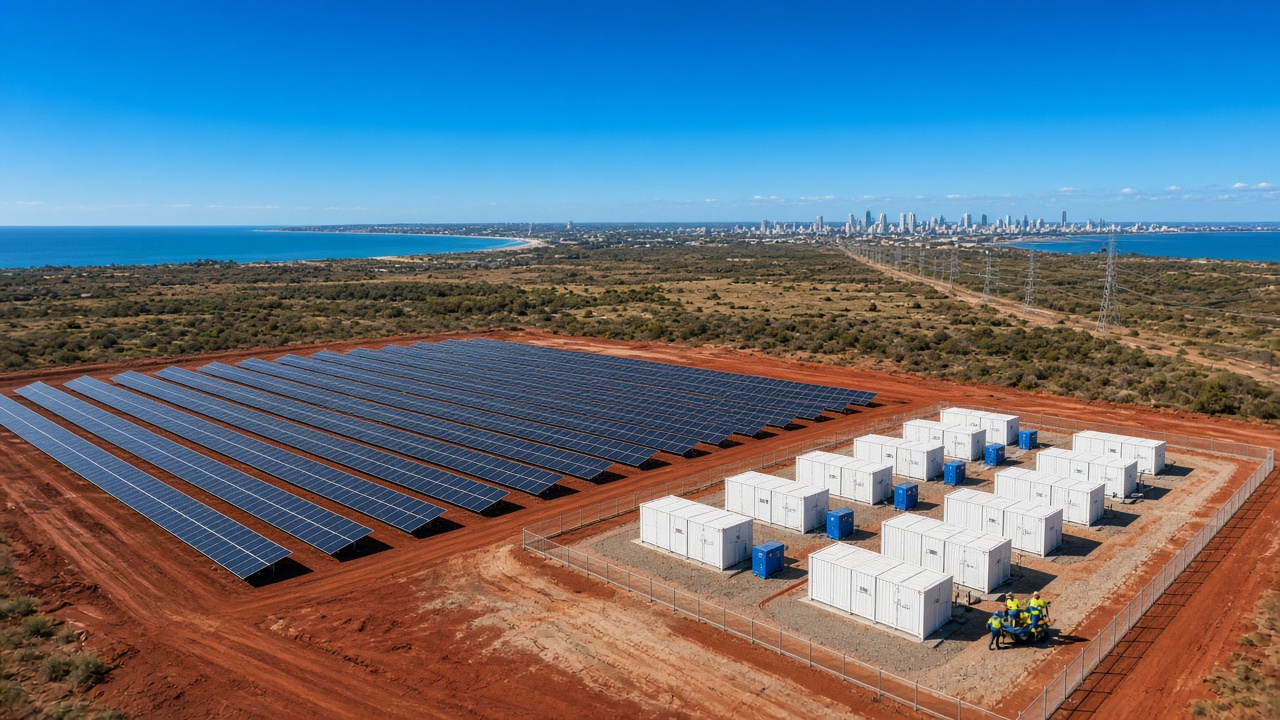
- Stage One is a 132 MW solar farm plus an 81.5 MW / 562 MWh battery, a 6.9-hour system, about 120 km south of Perth (Energy-Storage.News)
- Financial close is expected in November, subject to conditions including the Capacity Investment Scheme agreement with the Commonwealth and interest-rate hedging
- With the A$110 million equity placement completed in July, the debt is expected to fully fund Stage One through to first generation in 2028, with first drawdown forecast for the March quarter of 2027
- Frontier's executive chairman Jamie Cullen says construction activities "are ramping up"
On the delivery side, PV Tech reported that WA contractor Monford Group is the fixed-price EPC contractor, with full site mobilisation scheduled for September 2026. Frontier has also started substation EPC activities with Global Power Services and progressed Western Power tendering for interconnection works. Trina Storage is supplying the battery.
And there's more behind it. Frontier has outlined a multi-stage expansion at Waroona to approximately 1 GW of solar and 660 MW of battery storage by 2031, and the site sits just 0.5 km from Western Power's Landwehr Terminal.
What it means for you: DC string and inverter work, LV and HV cabling, battery container installation, SCADA and comms, testing and commissioning, then long-term operations and maintenance. Check out our explainers on solar farm electricians and the big battery boom.
Commercial solar: the $150 million manufacturer loans
This is the bit I think small and medium contractors should get most excited about. Big transmission and grid-scale projects go to the major players. But $150 million of low-interest loans for manufacturers to install solar, batteries and efficient equipment is classic commercial and industrial (C&I) work: factory rooftops, behind-the-meter batteries, switchboard upgrades, power factor correction, motor and drive upgrades, and energy monitoring.
Those manufacturers will need someone local to scope, design, install and maintain it all. If you already do commercial solar, now is the time to call your manufacturing clients and ask if they've seen the program. If you don't, it's a great reason to build the capability. Our post on commercial solar up to 1 MW covers the compliance side.
Plug-in solar: a brand-new category, with consultation open now
WA is also moving to become the first Australian state to legalise plug-in solar and batteries, aimed squarely at renters and apartment residents. We covered the original announcement here, but the details are now out for feedback.
According to the consultation page, updated on 4 November, the proposal would allow:
- Solar panel combinations up to 2 kW (DC)
- Inverter units up to 800 W (AC)
- Battery storage, with no upper limit on storage capacity in the proposed standard, which is modelled on the German plug-in solar standard
Feedback closes at 5 pm AWST on 9 December 2026. The government estimates a typical system could save a household around $240 a year, or about $500 with a battery.
What it means for you: these systems plug into a standard power point, so they won't be traditional install jobs. But someone will still need to check circuits, upgrade old switchboards, add RCD protection and advise strata managers. This is your chance to shape the rules, so if you have practical safety views, have your say before 9 December.
Household solar and batteries keep rolling
Don't forget the residential market either. More than 40% of homes on the SWIS already have rooftop solar, and more than 35,000 homes have installed batteries under the WA Residential Battery Scheme, according to the same government statement. The plan commits to ongoing support for household solar, batteries and EVs, which keeps residential sparkies busy too.
My take: what WA sparkies should do now
I'm genuinely optimistic about this. A clear target plus money already in the ground is exactly what contractors need to invest in people and gear with confidence. Here's where I'd focus:
- Get HV-ready. Transmission and substation work is in its electrical phase now. HV switching, testing and commissioning experience is the most valuable skill set in WA's energy market.
- Chase the EPC and subcontract chain. Big projects like Waroona are delivered through EPCs, which then subcontract electrical packages. Make sure the main WA renewable contractors know who you are.
- Build a commissioning skill set. Every solar farm and battery needs testing and commissioning, and that skill transfers across every project in the pipeline.
- Pitch C&I solar to manufacturers. The $150 million loan program is a door-opener. Lead with savings, not specs.
- Have your say on plug-in solar. Electricians know what goes wrong in the real world. Your feedback before 9 December makes the final rules better.
- Train apprentices now. Getting from 40% to 75% renewables in about five years needs more skilled hands. Contractors who start training now will have the crews when the work peaks.
WA is building a cleaner, cheaper grid, and sparkies are the people who'll actually make it happen. That's a great place to be.
Browse electrical jobs in Western Australia on ElectricalRoles