
What Does a Maintenance Electrician Do? Pay, Tickets and Pathways

What maintenance electricians really do in Australia and NZ: breakdowns, PLCs, shutdowns, tickets, real pay data, shift allowances and how to get started.
Every factory, hospital, mine, water plant and food line in Australia and New Zealand has one thing in common: when something stops, someone has to get it running again. Fast. That someone is the maintenance electrician, and honestly, it is one of the most underrated jobs in the trade.
Construction sparkies get the ribbon-cuttings. Maintenance sparkies keep the lights on afterwards, for decades. And with plants getting more automated every year, the job is turning into something closer to a hands-on technologist than a "fix-it" role. If you like solving puzzles, love a bit of tech and want steady work that isn't tied to the next building boom, read on.
What a maintenance electrician actually does
The short version from SEEK's role guide: maintenance electricians carry out preventive maintenance, diagnose faulty systems with test equipment, and repair or replace what's broken. The long version is a lot more interesting.
Breakdowns: the adrenaline part
A conveyor stops at 2 am. A pump trips at a water treatment plant. A packaging line in a food factory throws a fault code nobody has seen before. Breakdown work is about getting to the root cause quickly and safely: isolating, testing, reading drawings, checking the motor, the contactor, the overload, the drive, the sensor, then the PLC logic. Every minute of downtime costs the business money, so a good breakdown sparky is worth their weight in gold.
One SEEK reviewer with five to nine years in the job described it perfectly: "It's like a puzzle that requires solving." They also noted that you often have to consider mechanical issues when fault finding, because the problem isn't always electrical, even when everyone assumes it is.
Preventive and predictive maintenance: the smart part
The best maintenance teams spend more time stopping breakdowns than fixing them. That means scheduled work orders, inspecting and tightening terminations, cleaning and checking switchboards and motor control centres (MCCs), testing RCDs and emergency lighting, and logging everything in the site's maintenance system.
Then there's the predictive layer, which is where the job gets genuinely high-tech:
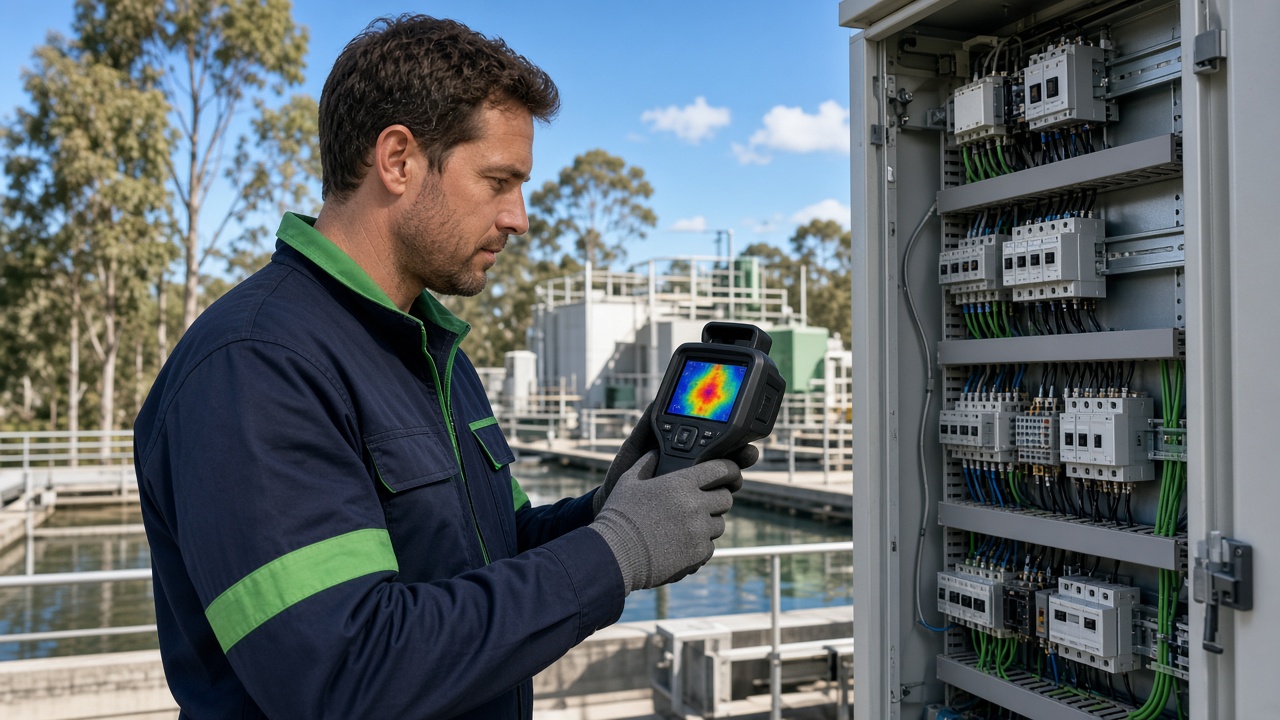
- Thermal imaging of switchboards, MCCs and connections to spot hot joints before they fail
- Motor condition checks, such as insulation resistance testing and vibration trends shared with the mechanical fitters
- Power quality monitoring to catch harmonics and voltage issues from drives and modern loads
- Data from sensors and SCADA that flags problems before an operator notices anything
PLCs, VSDs and motor control
Modern plants run on automation. Expect to work with variable speed drives (VSDs), soft starters, star-delta and DOL starters, MCCs, sensors, safety relays and PLCs. You don't need to be a controls engineer on day one, but being able to go online with a PLC, read the logic, check I/O and swap a faulty drive with the right parameters is what separates a good maintenance sparky from a great one. It's also where the pay jumps.
Compliance testing
Maintenance electricians keep sites legal and safe: RCD testing, emergency and exit lighting, test and tag, thermal surveys, switchboard inspections and keeping records an auditor will be happy with. Hospitals, aged care and food manufacturing take this especially seriously.
Shutdowns
Shutdowns are when a plant is deliberately stopped for big jobs: replacing switchgear, upgrading MCCs, swapping large motors, installing new drives. They are intense, often long days or nights, and usually pay very well. Many contract maintenance electricians build their year around shutdown seasons.
Where maintenance electricians work
Look at the live maintenance electrician ads on SEEK on any given day and the range is huge. When we checked in November 2026 they included food and beverage plants, meatworks, wineries, conveyor and automation companies, steel, paper and packaging, a university, a resort, airports and mail centres. Add in hospitals, water and wastewater plants, mines and processing plants, and you get a career that can follow you almost anywhere in Australia or New Zealand, from the big cities to regional towns.
Licences and tickets you'll need
Australia
The foundation is an electrical apprenticeship, usually four years, including a Certificate III in Electrotechnology Electrician, followed by your state or territory electrical licence (the "A-grade" in Victoria). Licensing varies by state, so check with your regulator. We've covered the whole process in our guide on how to get your electrical licence in Australia.
On top of the licence, maintenance employers commonly look for:
- Test and tag competency
- Hazardous areas (explosion protection) competencies for sites like fuel, chemical, grain, food and mining operations
- High risk work licences where relevant. For example, operating a boom-type elevating work platform with a boom of 11 metres or more needs a WP licence under the Safe Work Australia high risk work licence classes
- Site inductions such as confined space, working at heights and permit-to-work training, often provided by the employer
- PLC and VSD training, which is not a legal requirement but is a huge advantage
New Zealand
In NZ, you'll need to be registered and hold a practising licence with the Electrical Workers Registration Board (EWRB). The usual route is an electrical apprenticeship while holding a Trainee Limited Certificate, as Tahatū notes. The same extra tickets apply: hazardous areas, test and tag, and automation skills all make you more employable.
What maintenance electricians earn
Here's the real data, from sources we checked.
Australia
- SEEK: The average maintenance electrician salary in Australia is $105,000 to $125,000 a year, according to SEEK's November 2026 salary data, which is based on salary ranges in job ads. The highest-paying regions SEEK lists include Gladstone and Central Queensland (average $172,500), the Gold Coast ($147,500), Port Hedland, Karratha and the Pilbara ($145,000) and Sydney ($140,000).
- Jobs and Skills Australia: Across all electricians, median full-time earnings are $2,191 a week (roughly $114,000 a year), compared with $1,852 for all occupations, according to Jobs and Skills Australia using ABS data from May 2025.
- Award minimums: Under the Electrical, Electronic and Communications Contracting Award, the minimum rate for an Electrical worker grade 5 (a qualified tradesperson) is $1,119.10 a week, or $29.45 an hour, from 1 July 2026. Licensed electricians who may be required to use their unrestricted licence get an extra $40.29 a week licence allowance. Plenty of in-house factory maintenance roles fall under the Manufacturing Award instead, where the C10 tradesperson minimum is the same $1,119.10 a week.
That gap between the award floor and the SEEK averages tells you the story: the award is a safety net, and the market pays well above it for skilled maintenance sparkies, especially with automation skills, shift work and regional or remote locations.
Shift and on-call money
This is where maintenance electricians often out-earn their construction mates. Under the Contracting Award, for example:
- Afternoon and night shift is paid at 115% of the ordinary hourly rate
- Permanent night shift is paid at 130%
- Being on availability (on-call) duty earns an allowance of $98.48 a week
- Being called back to work after you've left site means you're paid for a minimum of four hours
Enterprise agreements at big manufacturers, mines and utilities are often more generous again, so always read the agreement, not just the ad.
New Zealand
The Master Electricians 2026 wage and salary survey (data collected in May 2026) puts the national average for a qualified industrial electrician at $36.48 an hour with one year's experience, rising to $47.05 an hour at eight years plus. That's roughly $98,000 a year at 40 hours a week before overtime and shift allowances. Tahatū lists the most common electrician pay as $66,000 to $107,000, with the upper end around $133,000.
The outlook: why this job keeps getting better
Jobs and Skills Australia counts 197,300 electricians employed in Australia, with annual employment growth of 7,200. Electricians are young too, with a median age of 33.
My view? Maintenance is one of the most future-proof corners of the trade. Every new automated warehouse, robotic food line, water upgrade, data centre and battery-backed factory adds equipment that needs looking after for 20 to 30 years. Construction work comes in waves. Maintenance work compounds. And as plants add more drives, sensors, solar and batteries, the sparky who can read a PLC and a thermal image is going to be in demand for a very long time.
The exciting bit is that the tools are getting better. Thermal cameras, wireless sensors, condition monitoring dashboards and AI-assisted maintenance planning mean less time chasing faults blind and more time fixing the right thing first. If you're tech-curious, this is a great time to be in it.
How to become (or level up as) a maintenance electrician
- Get licensed first. Finish your apprenticeship and licence (or EWRB registration in NZ). Nothing else matters without it.
- Get on the tools in an industrial environment. Even a couple of years in a factory, plant or mine builds the fault-finding instincts employers want.
- Learn automation. Do short courses on PLCs and VSDs, and ask the controls team if you can shadow them. This is the single biggest pay lever.
- Add the tickets. Hazardous areas, test and tag, EWP and confined space make you an easy hire for a wider range of sites.
- Say yes to shutdowns. They're hard work, but you'll learn more in two weeks than in six months of routine work, and the money is great.
- Pick your industry deliberately. Food and beverage, water, mining, health and logistics all have different rosters, pay and culture. Choose the one that suits your life.
- Think about the next step. Maintenance sparkies often move into instrumentation, FIFO mining, reliability or supervisor roles.
Ready for your next role?
If you like solving problems, enjoy tech and want a job that keeps critical things running, maintenance is a brilliant career path. Employers across Australia and New Zealand are hiring right now.
Browse maintenance and industrial electrician jobs on ElectricalRoles