
What Does a Rail Electrician Do? Pay, Tickets and Pathways
Signalling, traction power and depots: what rail electricians do in Australia and NZ, what the work pays, the tickets you need, and who's hiring right now.
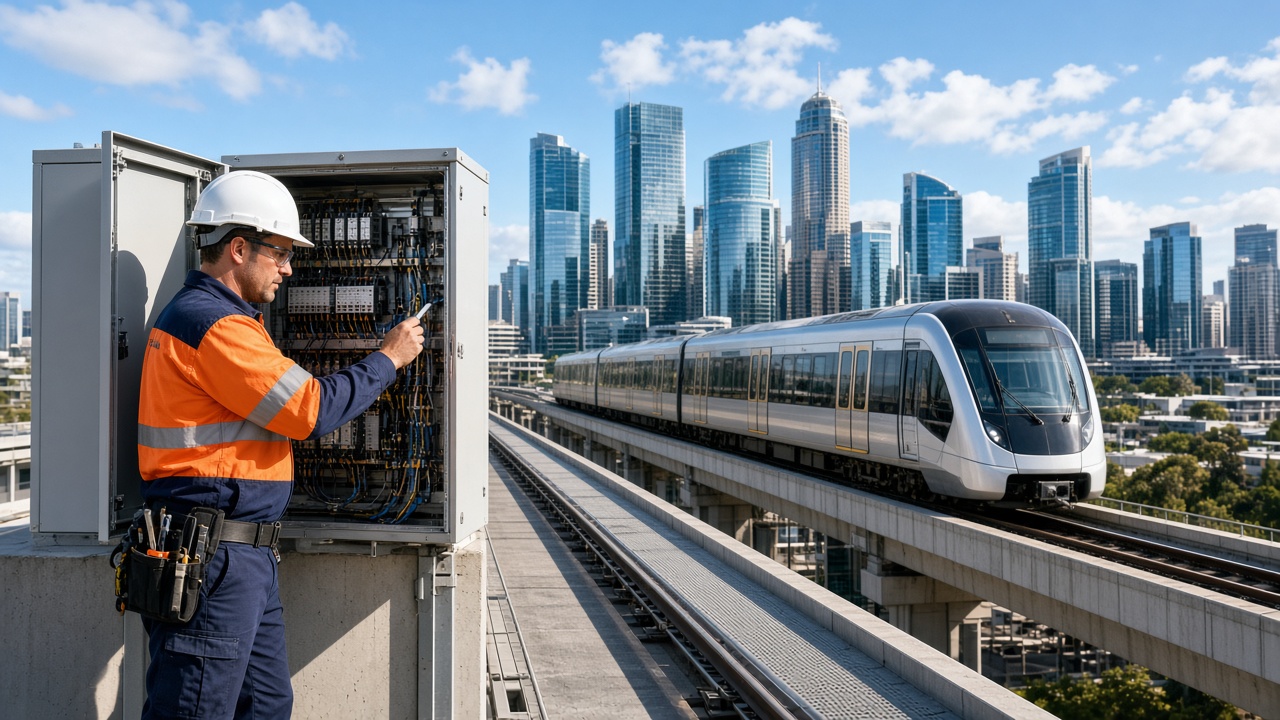
Here's a job most sparkies never think about until they're standing on a platform watching a train glide in on time: the rail electrician. Behind every signal that turns green, every overhead wire that powers a suburban train and every station lift, there are electricians who've chosen one of the most interesting, future-proof corners of our trade.
Rail is having a moment right now. Brisbane has digital signalling carrying passengers. Sydney Metro West is laying 60 km of track. Auckland's City Rail Link opened in September. And the Pilbara's heavy-haul lines need signal electricians on FIFO rosters. This is the next instalment of our "what does a ___ do" series, and I think it's one of the most underrated career moves an Aussie or Kiwi electrician can make.
What a rail electrician actually does
"Rail electrician" is an umbrella term. In practice, you'll usually land in one of these streams:
- Signalling electrician. Installing, terminating and testing the safety-critical gear that controls train movements: signals, points machines, track circuits, axle counters, location cases and signalling equipment rooms (often called bungalows or huts). On newer lines this extends to digital train control such as ETCS.
- Traction power and overhead wiring. Working on the systems that actually power the trains: overhead wiring, traction substations, and the feeders and protection behind them. Systems differ by city. Sydney and Melbourne run 1500 V DC, while Brisbane, Perth and Auckland run 25 kV AC, so the skills and safety rules vary.
- Rolling stock electrician. Based in depots and maintenance facilities, fault-finding and maintaining train electrical systems, from traction equipment and auxiliary power to doors, lighting and onboard electronics.
- Stations and corridor services. Lighting, power, lifts and escalators, CCTV, communications and low-voltage systems across stations, tunnels and the rail corridor.
The day-to-day work looks like the job ads. John Holland is currently advertising for an Electrician (Rail Signalling) in the Pilbara on a 2/1 roster with Perth as point of hire. The role covers installing and removing power and signal cable, terminating train stop and points disconnection boxes, main and subsidiary signals, location cases, signalling bungalow equipment and track circuits, plus cable jointing and helping with testing. In other words, it's precise, high-stakes termination work done in a team.
Over in Brisbane, Hitachi Rail is hiring a Railway Electrician to work on its ETCS Level 2 project. The role means interpreting signalling drawings and construction documentation, working alongside the Signalling Electrical Supervisor and delivering the electrical works to plan. Hitachi asks for a trade qualification in signalling and/or electrical, plus at least two years in railway signalling, ideally in a brownfield (live, existing) railway.
Why rail is such a good bet right now
I love this corner of the industry because it's where old-school electrical craft meets genuinely cutting-edge technology. A few current examples:
Brisbane's digital signalling is live. As Railway Gazette reported, Queensland Rail began carrying passengers on ETCS Level 2 trains in September, starting with weekend shuttles on the Shorncliffe branch. It's being delivered by the Sequence Alliance (Transport and Main Roads, Hitachi Rail, the Cross River Rail Delivery Authority and Queensland Rail). Work is underway in the Cross River Rail tunnels, and contracts have been placed for the Sunshine Coast and Gold Coast lines as part of a 12-stage rollout ahead of Brisbane 2032. That's years of signalling work.
Sydney Metro West is in full swing. According to Sydney Metro's November update, John Holland is delivering the Linewide package: 60 km of track, rail systems installation and a 38-hectare stabling and maintenance facility at Clyde. Quickway is installing HV conduits to the Rosehill services facility. At Five Dock, a substation is being delivered and installed over nights from 18 to 20 November. The line is targeting a 2032 opening, so rail systems, HV and fit-out work will keep growing towards that date.
Auckland's network just stepped up. The City Rail Link opened to passengers on 13 September 2026. A bigger, busier network means more maintenance, more signalling and more depot work for years to come.
New Zealand's regions are hiring too. KiwiRail is advertising for an experienced Signals Technician (Level 3/4) in Napier, applications close 15 November. That role maintains, tests and repairs signalling equipment, track circuits, level crossings and interlockings, and needs EWRB registration with a current practising licence. For people coming in fresh, there's a Signals Technician Trainee role in Hamilton (closes 27 November) with paid training, 4 x 10-hour shifts, and an electrical trade background listed as a plus.
What it pays
Honest answer: rail pay varies a lot by employer, state and stream, and it's mostly set by enterprise agreements rather than one award rate. A state operator, a private signalling contractor and a FIFO heavy-haul project can pay very differently for similar skills.
As a rough guide, careers site careertips puts the median full-time salary for a railway signal electrician at about $111,800 a year (2024 figure), with modelled estimates of around $119,000 for 2026. They flag this as an indicative estimate that hasn't yet been checked against official data, so treat it as a starting point, not a promise. What pushes your take-home well above the base:
- Shift and possession work. A lot of rail work happens at night and on weekends during track closures (possessions), and that's where penalty rates add up.
- FIFO and remote rosters. Pilbara signalling roles like the John Holland 2/1 roster usually come with remote and roster loadings.
- Signalling competencies. Higher signalling qualifications, testing authorisations and digital signalling experience (ETCS, CBTC) are scarce, and scarcity pays.
- Stepping up. Moving into supervisor, tester or signalling engineering roles lifts the base rate considerably.
When you're comparing offers, always ask for the total package (base, allowances, penalties, super and roster loadings) rather than just the hourly rate. I've seen people turn down rail jobs that would've paid them more overall because they only compared the base.
Tickets and pathways
In Australia, most rail electricians start with a standard electrical trade: the UEE30820 Certificate III in Electrotechnology Electrician and a full electrical licence in their state. From there you'll typically need:
- Rail safety inductions and track access tickets, which differ by network and state (for example, many networks use a Rail Industry Worker card system).
- A rail safety worker health assessment, under the national standard for the health assessment of rail safety workers. Expect a medical, plus drug and alcohol testing on most networks.
- Signalling-specific training if you go down the signalling path, often delivered on the job by your employer as you progress through competency levels.
- For traction roles, specific HV and network authorisations, issued by the network operator.
In New Zealand, you'll want EWRB registration with a current practising licence for experienced roles, and a full Class 1 driver's licence (KiwiRail lists both). Trainee pathways like KiwiRail's Hamilton role need NCEA Level 1 maths, English and science and a willingness to travel, and they actively value an electrical background. For Aussie sparkies eyeing a move across the Tasman, our guide to getting licensed and working in NZ covers the mutual recognition steps.
Is it right for you?
Rail suits electricians who:
- Love precision. Signalling is safety-critical. Every termination is checked and documented, and "near enough" doesn't exist.
- Don't mind nights and weekends. Possessions are a reality. Plenty of people end up loving the rhythm and the penalty rates.
- Like being part of something visible. There's real pride in pointing at a new metro line and saying "I wired that".
- Want a future-proof skill. Digital signalling, electrified networks and growing cities mean demand isn't going anywhere.
If you're coming from industrial, substation or cable jointing work, you'll find a lot of your skills carry straight over, especially terminations, drawings and HV awareness.
How I'd break in
- Get your trade and licence sorted first. Rail employers want solid electricians, and they'll teach you the rail-specific parts.
- Pick up your rail inductions early. Having a current rail safety induction and medical makes you instantly more employable on contractor crews.
- Start with a contractor on a major project. Projects like Sydney Metro West, Cross River Rail and the Pilbara networks hire in waves. Getting on one is the fastest way to build signalling experience.
- Say yes to the testing and commissioning work. That's where you learn how the whole system fits together, and it's the fastest path to higher pay.
- Look at trainee programmes in NZ. KiwiRail-style trainee roles are a brilliant way in if you're early in your career.
Rail is one of those quiet success stories in our industry: stable, well paid, technically rich and growing in every major city. If it sounds like your kind of work, check out the latest rail and signalling jobs on ElectricalRoles.com.au and start building towards it.